At a glance
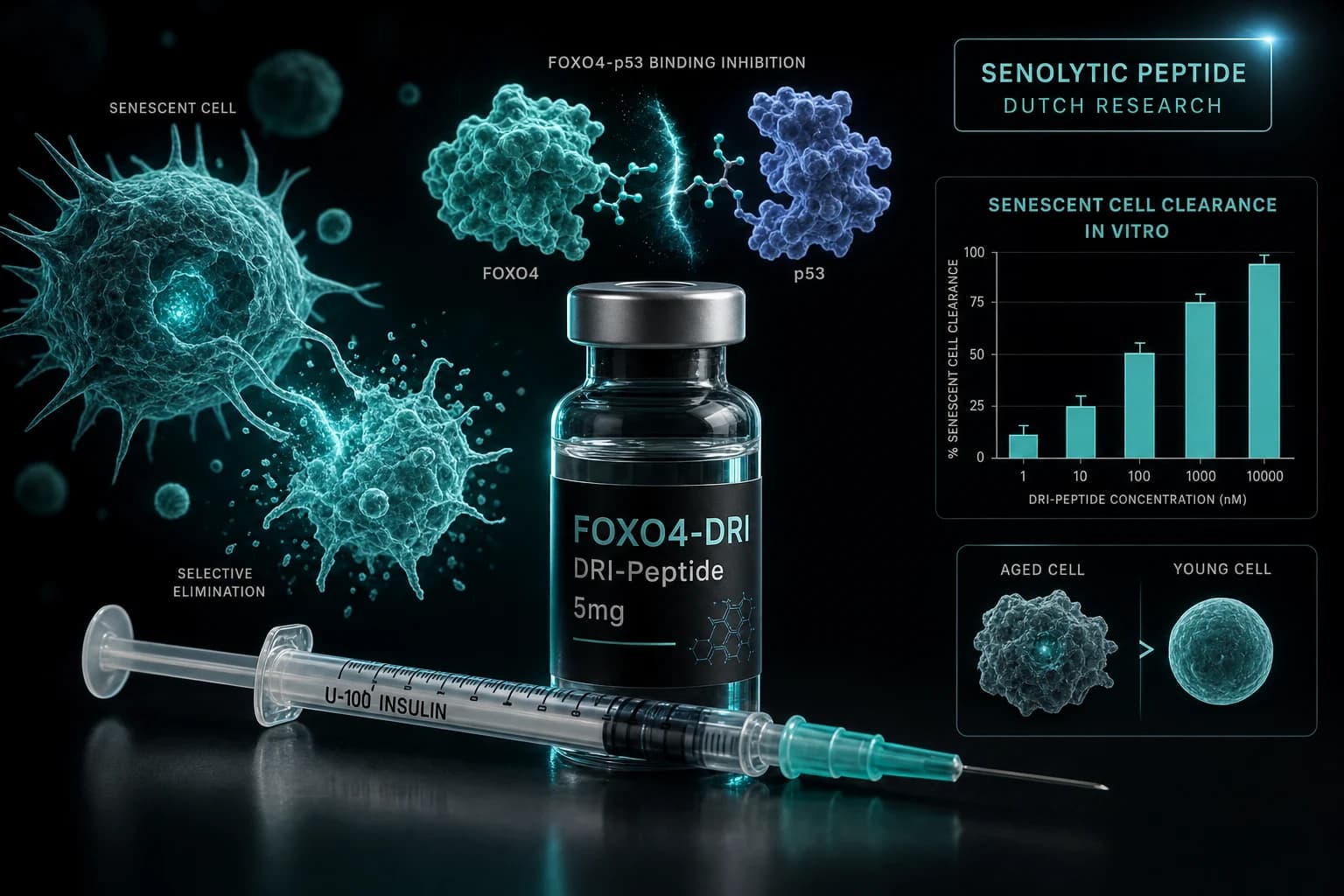
- FOXO4-DRI is a D-retro-inverse modified peptide that blocks the FOXO4-p53 interaction maintaining senescent cells; allows p53 to drive apoptosis in those cells
- Originally developed by the Demaria lab (Buck Institute / University of Groningen); the Cell 2017 publication established the senolytic mechanism
- Aged mouse studies showed improved fitness, fur quality, and renal function after FOXO4-DRI treatment, with senescent cell clearance documented in tissue
- No human clinical trials as of May 2026; the compound has not advanced beyond preclinical and is sold only as research-grade
- The senolytic class also includes the small-molecule combination dasatinib + quercetin (D+Q), navitoclax, and fisetin; FOXO4-DRI is the peptide-specific option
FOXO4-DRI is one of the most-distinctive entries in the longevity peptide research catalog. The compound is a D-retro-inverse modified peptide designed to disrupt the FOXO4-p53 protein-protein interaction that allows senescent cells to evade apoptosis. The 2017 Cell publication by the Demaria lab established the mechanism and showed striking aged-mouse phenotypes after FOXO4-DRI treatment. The compound has been a focal point of senolytic peptide research since but has not advanced to human clinical trials.
This article covers what FOXO4-DRI actually is, the senolytic mechanism it targets, the preclinical evidence base, the standard research protocols, and where it fits in 2026 longevity research alongside small-molecule senolytics like dasatinib + quercetin and fisetin.
What FOXO4-DRI actually is
FOXO4-DRI (also written FOXO4-D-Retro-Inverse) is a modified peptide based on a fragment of the FOXO4 transcription factor:
| Property | FOXO4-DRI value |
|---|---|
| Format | D-retro-inverse modified peptide |
| Structure | Reversed sequence using D-amino acids instead of natural L-amino acids |
| Origin | Designed from FOXO4 protein binding domain |
| Mechanism | Blocks FOXO4-p53 interaction in senescent cells |
| Developer | Demaria lab (Buck Institute / University of Groningen) |
| Route | Intravenous, intraperitoneal, or subcutaneous in preclinical studies |
| Stage | Preclinical only |
The D-retro-inverse modification is key to the compound's pharmacological properties. Natural L-peptides are rapidly degraded by proteases in circulation. D-amino acid peptides (mirror-image structures) are resistant to protease degradation and have extended half-life. The "retro-inverse" approach reverses the sequence in addition to using D-amino acids, preserving the binding interface geometry while reading the sequence in opposite direction.
The result is a peptide that:
- Binds the same target as the natural FOXO4 fragment
- Resists proteolytic degradation
- Has substantially extended half-life
- Maintains functional binding activity
For broader longevity peptide research context, see the Epitalon telomerase activation research and the SS-31 vs MOTS-c mitochondrial peptide head-to-head.
The senolytic mechanism
Cellular senescence is a state cells enter after acute stress or DNA damage. Senescent cells stop dividing but remain metabolically active and secrete a senescence-associated secretory phenotype (SASP) that contributes to chronic inflammation and aging-related dysfunction.
The mechanistic puzzle: senescent cells should die. They are damaged, dysfunctional, and harmful to surrounding tissue. But they persist for years through specific anti-apoptotic mechanisms. One of these mechanisms is the FOXO4-p53 interaction:
- p53 normally drives apoptosis in damaged cells
- In senescent cells, FOXO4 binds p53 and sequesters it from apoptosis-promoting activities
- This allows senescent cells to evade the apoptotic clearance that would normally remove them
- Disrupting the FOXO4-p53 interaction releases p53 to drive apoptosis specifically in senescent cells
FOXO4-DRI is designed to block exactly this interaction. The peptide competitively binds FOXO4 at the p53 interaction site, releasing p53 to drive apoptosis. Importantly, the effect is selective for senescent cells because the FOXO4-p53 dependency is specific to that cellular state.
Key publication. Baar et al., Cell, 2017 established the FOXO4-DRI mechanism and showed striking aged-mouse phenotypes:
- Improved fitness and physical performance
- Improved fur quality and density
- Improved renal function
- Documented senescent cell clearance in multiple tissues
The aged mouse phenotypic improvements were the result that drew substantial research interest to FOXO4-DRI as a longevity peptide.
Bottom line: FOXO4-DRI's mechanism is mechanistically elegant: selectively clear senescent cells by disrupting their specific anti-apoptotic mechanism. The aged mouse phenotype results are striking. The translation to humans has not been tested.
The broader senolytic class
FOXO4-DRI is one of several senolytic approaches in research:
| Compound | Type | Status | Mechanism |
|---|---|---|---|
| FOXO4-DRI | Peptide | Preclinical | FOXO4-p53 disruption |
| Dasatinib + Quercetin (D+Q) | Small molecule combination | Clinical trials | Bcl-2 family pathway |
| Navitoclax | Small molecule | Clinical trials (cancer) | Bcl-2 inhibitor |
| Fisetin | Natural flavonoid | Some human studies | Multiple senolytic mechanisms |
| UBX0101 | Small molecule | Phase 2 (osteoarthritis) | p53-targeted |
The clinical translation of senolytics has been mixed. D+Q has had some Phase 2 trials with mixed results. Fisetin has more human data but with smaller effect sizes. Navitoclax has cancer trial data but is not specifically developed as an anti-aging senolytic.
FOXO4-DRI is the peptide-specific senolytic option but lacks human trial data. Researchers interested in the senolytic mechanism but wanting human-validated compounds typically choose D+Q or fisetin rather than FOXO4-DRI.
For broader longevity research context, see the Epitalon telomerase activation research, SS-31 vs MOTS-c mitochondrial peptide head-to-head, and Pinealon nucleopeptide anti-aging research.
Standard research protocols
FOXO4-DRI research protocols vary by application:
| Phase | Dose | Route | Frequency | Duration |
|---|---|---|---|---|
| Preclinical (mouse) | Variable | IV, IP, SC | Variable | Per study |
| Forum-documented research | 0.5-5 mg/kg | SC | Every 3-5 days | 1-2 cycles |
| Higher | 5-10 mg/kg | SC | Every 3-5 days | 1-2 cycles |
These doses are extrapolations from the published mouse studies to human research applications. There is no published human dose-response data. The intermittent dosing pattern (every 3-5 days rather than daily) reflects the senolytic strategy of pulsed clearance rather than continuous suppression.
The cyclic structure (1-2 cycles per year) is the pattern most discussed in longevity research circles. The rationale: senescent cells accumulate gradually, periodic clearance is more efficient than continuous low-dose suppression.
For research-grade reconstitution, see the reconstitution calculator.
Why no human clinical trials yet
Three factors have kept FOXO4-DRI in preclinical:
1. No commercial sponsor. The compound emerged from academic research without a major pharma partnership. Advancing a research peptide to clinical trials requires substantial investment that academic labs generally cannot fund alone.
2. Manufacturing complexity. D-retro-inverse peptide synthesis is more complex than standard L-peptide synthesis. Commercial-scale manufacturing requires specific expertise.
3. Regulatory complexity. Senolytic mechanisms are novel for the FDA framework. Selecting appropriate endpoints, patient populations, and trial designs for senolytic peptides is not well-established.
4. Competition from small-molecule senolytics. Dasatinib + quercetin and fisetin have advanced into human trials with cheaper manufacturing and existing regulatory pathways. The opportunity cost of advancing FOXO4-DRI versus pursuing small-molecule senolytics has favored the latter.
Safety profile
The published mouse studies reported FOXO4-DRI as well-tolerated at doses producing senolytic effects. Key observations:
- No major adverse events in published animal studies
- Selective senescent cell clearance without major effects on non-senescent cells
- No documented severe toxicity at standard research doses
What is unknown:
- Long-term human safety at therapeutic dosing
- Effects in patients with various senescence-related conditions
- Interactions with other anti-aging or cancer-related medications
- Pediatric, pregnancy, and breastfeeding contexts
The theoretical concern with any senolytic intervention is "right cell clearance" versus "off-target clearance." If senolytics affect cells that are not senescent in the specific harmful sense, the benefit-risk math changes.
How FOXO4-DRI fits the 2026 regulatory landscape
FOXO4-DRI is not FDA-approved. It is not among the peptides reclassified in the February 27, 2026 HHS announcement. It remains a research-grade compound without compounding-pharmacy access through standard 503A pathways.
Research-grade retail availability through peptide vendors is the practical channel.
For broader regulatory context, see the FDA peptide reclassification February 2026 complete breakdown.
Sourcing
Research-grade FOXO4-DRI availability is more limited than common research peptides because the D-retro-inverse manufacturing is complex. Quality verification matters substantially.
For our broader sourcing analysis, see the best legit peptide vendors 2026 ranking.
FAQ
What is FOXO4-DRI?
FOXO4-DRI is a D-retro-inverse modified peptide designed to disrupt the FOXO4-p53 protein-protein interaction that maintains senescent cells. By blocking this interaction, the peptide allows p53 to drive apoptosis specifically in senescent cells, providing a selective senolytic mechanism.
Has FOXO4-DRI been tested in humans?
No published human clinical trials exist as of May 2026. The compound has not advanced beyond preclinical (animal and cell culture) research despite the 2017 Cell publication generating substantial research interest.
What did the aged mouse studies show?
The pivotal Baar et al., Cell, 2017 study showed FOXO4-DRI treatment of aged mice produced improved fitness, improved fur quality, improved renal function, and documented senescent cell clearance in multiple tissues. The phenotypic improvements were the striking finding that drew attention to the compound.
How does FOXO4-DRI compare to other senolytics?
FOXO4-DRI is the peptide-specific senolytic option. Small-molecule senolytics include dasatinib + quercetin (D+Q, the most-studied combination in human trials), navitoclax (BCL-2 inhibitor, mostly in cancer trials), and fisetin (natural flavonoid with some human data). For research wanting human-validated senolytics, the small molecules are the practical choice; for research targeting the specific FOXO4-p53 mechanism, FOXO4-DRI is the direct tool.
What is a standard FOXO4-DRI research dose?
Forum-documented research-use protocols typically use 0.5-5 mg/kg subcutaneous every 3-5 days for 1-2 cycles. These doses are extrapolations from the published mouse studies. There is no human dose-response data.
Why hasn't FOXO4-DRI gone into clinical trials?
Combination of factors: no major pharma sponsor stepping forward, D-retro-inverse peptide manufacturing complexity, regulatory uncertainty around novel senolytic endpoints, and competition from cheaper-to-manufacture small-molecule senolytics that have advanced into human trials.
Is FOXO4-DRI legal?
The compound is sold for research purposes by peptide vendors under research-use disclosures. It is not approved by the FDA or any major regulatory authority and is not subject to compounding-pharmacy access following the February 27, 2026 reclassification.
Further reading
- Epitalon telomerase activation research
- SS-31 vs MOTS-c mitochondrial peptide head-to-head
- Pinealon nucleopeptide anti-aging research
- SS-31 (Elamipretide) FDA-approved mitochondrial peptide
- MOTS-c mitochondrial exercise peptide guide
- NAD+ injection protocol 2026
- FDA peptide reclassification February 2026 complete breakdown
- Best legit peptide vendors 2026
This article is for educational and research purposes only. FOXO4-DRI is sold under research-use disclosures and is not approved by the FDA. No published human clinical trials exist as of May 2026. None of the content above constitutes medical advice. The senolytic field is early-stage; researchers interested in human-validated senolytic interventions should consult current Phase 2/3 trial activity for small-molecule senolytics (D+Q, fisetin, navitoclax).