At a glance
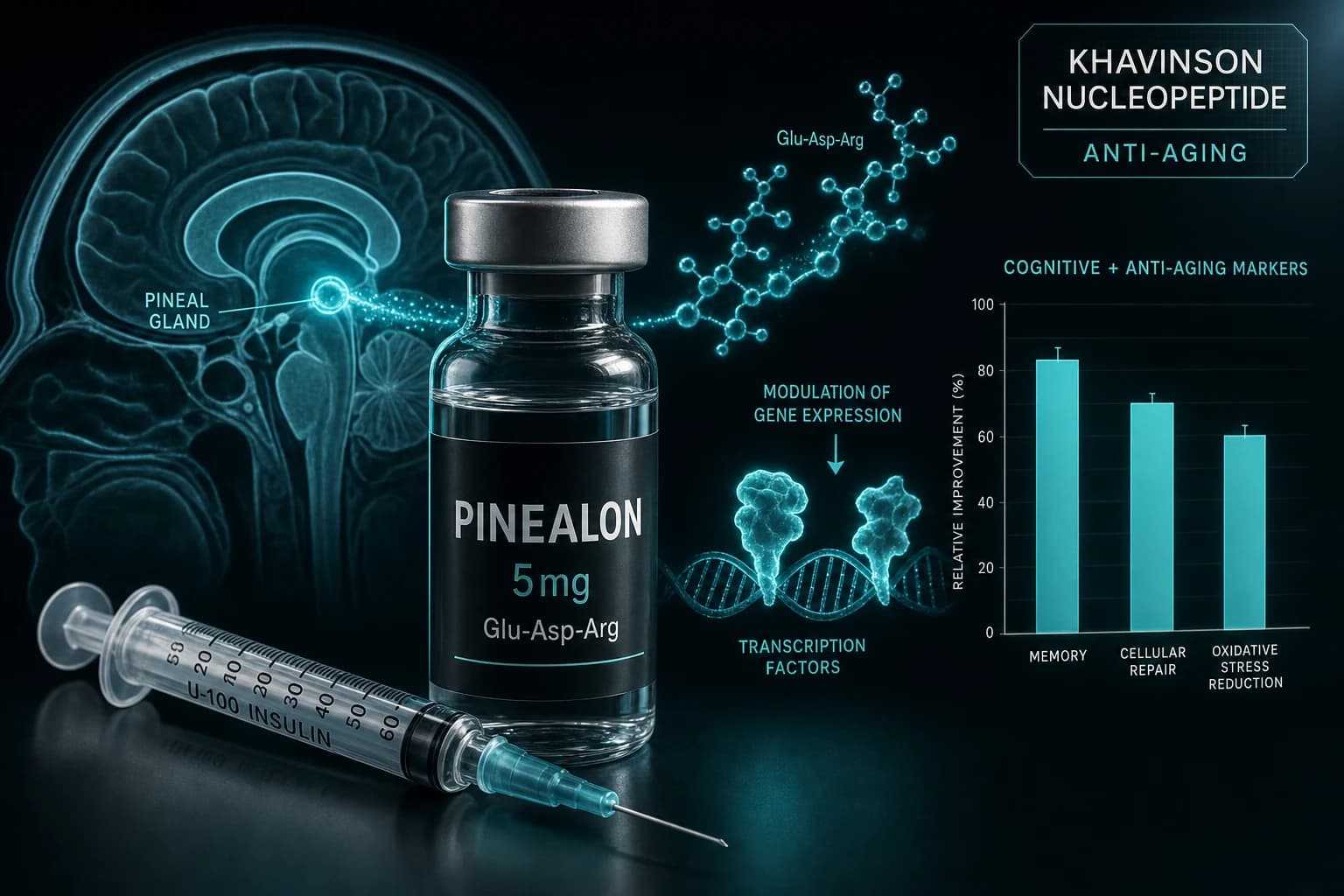
- Pinealon is a Russian-developed synthetic tripeptide Glu-Asp-Arg (Glutamic acid - Aspartic acid - Arginine), part of the Khavinson short peptide family
- Standard research dose: 100-200 mcg subcutaneous daily for 10-20 day cycles; oral capsule protocols use 100-200 mcg daily
- Mechanism: Khavinson model proposes specific DNA-binding tripeptides modulate gene expression patterns in target tissues; cognitive and neuroprotective effects documented in animal models
- Most research evidence is from St Petersburg Institute of Bioregulation and Gerontology (Khavinson lab) and is not widely replicated outside Russian research community
- Effect magnitudes in published trials are modest; the broader Khavinson tripeptide family includes Epitalon (Ala-Glu-Asp-Gly), Vesugen (Lys-Glu-Asp), and Cortagen (Ala-Glu-Asp-Pro)
Pinealon is one of the synthetic short peptides developed by the Khavinson lab at the St Petersburg Institute of Bioregulation and Gerontology in Russia. The compound is a tripeptide (Glu-Asp-Arg) marketed as a cognitive and anti-aging research peptide, with proposed mechanism involving DNA-binding-based modulation of gene expression in pineal gland and related neural tissues. The Khavinson "short peptide" concept has produced multiple related compounds, with Epitalon (Ala-Glu-Asp-Gly) being the best-known example.
This article covers what Pinealon is, the Khavinson short peptide framework that underpins its proposed mechanism, the published evidence base (largely from Russian research with limited Western replication), the standard research protocols, and where the compound fits in 2026 anti-aging research.
What Pinealon actually is
Pinealon is a synthetic tripeptide composed of three amino acids:
| Property | Pinealon value |
|---|---|
| Sequence | Glu-Asp-Arg (Glutamic acid - Aspartic acid - Arginine) |
| Length | 3 amino acids |
| Class | Khavinson short peptide |
| Developer | St Petersburg Institute of Bioregulation and Gerontology |
| Half-life | Short (minutes); rapid clearance |
| Routes | Subcutaneous injection, oral capsule |
| Stage | Russian research peptide; no FDA approval |
The "Pinealon" name reflects the proposed target tissue (pineal gland) although the practical effects extend beyond pineal-specific endpoints. The Khavinson research framework proposes that specific short peptides bind specific DNA promoter regions to regulate transcription of genes relevant to the target tissue.
For the broader Russian short-peptide context, see the Selank nasal vs injection dosing guide and the Epitalon telomerase activation research (covers the related Khavinson compound).
The Khavinson short peptide framework
Vladimir Khavinson's research group at the St Petersburg Institute developed a series of synthetic short peptides over several decades. The framework proposes:
- Specific tripeptide and tetrapeptide sequences bind specific DNA promoter regions
- The binding modulates transcription of genes specific to particular tissues
- The peptide-DNA interaction is highly sequence-specific
- Tissue-specific gene regulation produces tissue-specific effects (anti-aging, regenerative, etc.)
The Khavinson family of short peptides includes:
| Peptide | Sequence | Target tissue |
|---|---|---|
| Epitalon | Ala-Glu-Asp-Gly | Pineal gland, telomerase |
| Pinealon | Glu-Asp-Arg | Pineal gland, cognitive |
| Vesugen | Lys-Glu-Asp | Vascular endothelium |
| Cortagen | Ala-Glu-Asp-Pro | Adrenal cortex |
| Vilon | Lys-Glu | Thymus, immune |
| Cardiogen | Ala-Glu-Asp-Arg | Cardiac tissue |
| Livagen | Lys-Glu-Asp-Ala | Liver |
This framework is more accepted in Russian than in Western research. The mechanism (sequence-specific DNA binding by very short peptides) is biochemically unusual; most transcription factors are much larger proteins with extended DNA-binding domains. The Khavinson short peptides' proposed mechanism implies a unique mode of DNA-protein interaction that has not been broadly validated in Western biochemistry.
For Western readers: the published Russian evidence is genuine research, but the mechanism case is less well-characterized than for compounds with clearer Western trial data. Researchers should approach Pinealon and other Khavinson peptides with awareness of this mechanism uncertainty.
Published evidence
Pinealon-specific evidence comes predominantly from Russian research:
Animal cognitive effects. Multiple Russian studies show Pinealon supports cognitive function in aged rats, with measurable improvements in learning tasks and memory consolidation.
Anti-aging markers. Studies in cell culture and animal models report Pinealon affects oxidative stress markers, cellular senescence pathways, and various aging biomarkers.
Pineal gland effects. The compound's namesake target tissue (pineal gland) shows changes in melatonin synthesis and circadian regulation in some studies.
Western validation. Limited. Most Pinealon publications are from the Khavinson lab and St Petersburg-affiliated researchers. Independent replication in Western research institutions has been minimal.
For broader Russian peptide context, see Cerebrolysin neurodegenerative protocol guide (Austrian compound) and Calm + Clarity Selank Pinealon PE-22-28 cognitive stack.
Standard research protocols
Pinealon research protocols vary by route:
| Route | Dose | Frequency | Duration |
|---|---|---|---|
| Subcutaneous injection | 100-200 mcg | Once daily | 10-20 day cycles |
| Oral capsule | 100-200 mcg | Once daily | 10-30 day cycles |
| Cycle repeat | Same protocol | Per cycle | Repeat 6-monthly |
The cycle structure (10-30 day protocols repeated periodically) is consistent across the Khavinson short peptide family. The framework proposes that the cycle structure allows the peptide effects to consolidate without continuous exposure.
Oral protocols are sometimes preferred for Khavinson short peptides because of the convenience and because the Khavinson framework proposes that gut absorption is adequate for the proposed mechanism. The pharmacokinetic justification for this is less well-characterized than for compounds with established oral bioavailability data.
Combinations with related compounds
Pinealon is sometimes combined with other Khavinson short peptides or with related cognitive research peptides:
Pinealon + Epitalon. Combines pineal-gland-focused short peptide effects. See Epitalon telomerase activation research.
Pinealon + Selank. Combines anti-aging short peptide with anxiolytic peptide for cognitive research applications. See the Calm + Clarity Selank Pinealon PE-22-28 cognitive stack.
Pinealon + Semax. Combines Khavinson short peptide with cognitive enhancement peptide.
These combinations are typical in Russian cognitive research protocols. The empirical data on combinations is mostly anecdotal in the Western research context.
Safety profile
Pinealon and other Khavinson short peptides have generally been reported as well-tolerated in published Russian research and in forum-documented research-use protocols:
- Minimal acute side effects at standard research doses
- No documented dependence or tolerance with cyclic dosing patterns
- No major reported adverse events in research-use applications
- Long-term safety database is limited to Russian research; Western trial validation is minimal
For research subjects, the conservative position is short cycles (10-20 days), defined washouts between cycles, and absence of stacked protocols that might produce unexpected interactions.
How Pinealon fits the 2026 regulatory landscape
Pinealon is not approved by the FDA or any major Western regulatory authority. The compound is not among the peptides reclassified in the February 27, 2026 HHS announcement. It remains a research-grade compound without compounding-pharmacy access through standard 503A pathways.
Research-grade retail availability through peptide vendors continues to be the practical channel in Western markets. Russian and CIS pharmaceutical markets have different regulatory status.
For broader regulatory context, see the FDA peptide reclassification February 2026 complete breakdown.
Sourcing
For research-grade Pinealon, Limitless Biotech carries it in the oral peptide catalog with code ENHANCED. Injectable Pinealon vials are also available through some research peptide vendors.
For our broader sourcing analysis, see the best legit peptide vendors 2026 ranking.
FAQ
What is Pinealon?
Pinealon is a synthetic tripeptide (Glu-Asp-Arg) developed by the Khavinson lab at the St Petersburg Institute of Bioregulation and Gerontology in Russia. It is part of the Khavinson "short peptide" family of compounds designed for tissue-specific gene regulation effects through proposed sequence-specific DNA binding.
What does Pinealon do?
The proposed mechanism is sequence-specific DNA binding that modulates gene expression in pineal gland and related neural tissues. The clinical effect profile in published research includes cognitive support, anti-aging marker improvements, and effects on circadian regulation. Effect magnitudes in published trials are modest.
What is the standard Pinealon research dose?
100-200 mcg subcutaneous or oral once daily for 10-20 day cycles, repeated every 6 months. The cycle structure with defined washouts is typical of the Khavinson short peptide framework.
Is the Khavinson short peptide mechanism real?
The published Russian evidence is genuine research, but the proposed mechanism (sequence-specific DNA binding by very short peptides) is biochemically unusual and has not been broadly validated in Western research institutions. Researchers should approach Khavinson short peptides with awareness of the mechanism uncertainty and the limited independent replication.
How does Pinealon compare to other Khavinson short peptides?
Pinealon (Glu-Asp-Arg) is proposed to target pineal gland and cognitive endpoints. Epitalon (Ala-Glu-Asp-Gly) is the most-studied Khavinson compound, with telomerase activation as the proposed mechanism. Vesugen, Cortagen, Vilon, and others target different tissues. The framework proposes each sequence binds its specific DNA target.
Can I combine Pinealon with other peptides?
Common combinations in Russian research protocols include Pinealon + Epitalon, Pinealon + Selank, and Pinealon + Semax. The Khavinson lab proposes that combining tissue-specific short peptides addresses multiple aging mechanisms simultaneously. Empirical data on combinations is mostly anecdotal in Western contexts. See the Calm + Clarity Selank Pinealon PE-22-28 cognitive stack.
Is Pinealon legal?
Pinealon is sold for research purposes by peptide vendors under research-use disclosures. It is not approved by the FDA or major Western regulatory authorities. It is not among the peptides reclassified in the February 27, 2026 HHS announcement. Russian and CIS markets have different regulatory status.
Further reading
- Epitalon telomerase activation research
- Selank nasal vs injection dosing guide
- Calm + Clarity Selank Pinealon PE-22-28 cognitive stack
- Cerebrolysin neurodegenerative protocol guide
- Dihexa BDNF mimetic dosing evidence audit
- Best legit peptide vendors 2026
This article is for educational and research purposes only. Pinealon is sold under research-use disclosures and is not approved by the FDA or any other major Western regulatory authority. None of the content above constitutes medical advice. The Khavinson short peptide mechanism framework has not been broadly validated in Western research; researchers should approach with awareness of the mechanism uncertainty.