At a glance
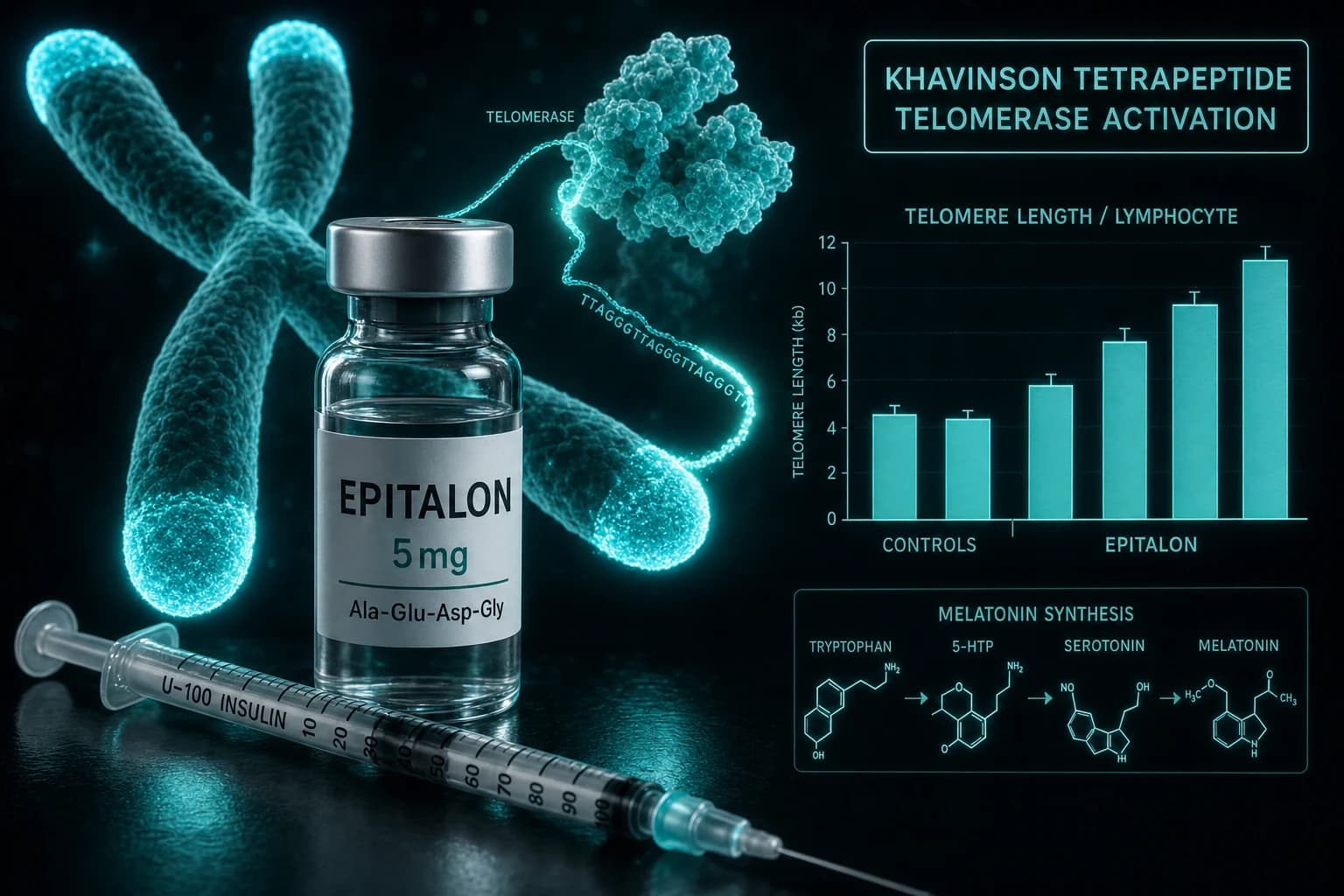
- Epitalon (Epithalon, Ala-Glu-Asp-Gly) is a Russian-developed synthetic tetrapeptide from the Khavinson short peptide family
- Standard research protocol: 5-10 mg subcutaneous daily for 10-20 day cycles, repeated every 6 months
- Published mechanism: telomerase activation in human cell culture; Russian clinical studies show effects on aging biomarkers and circadian regulation
- Khavinson 1986-2003 series of human studies report modest improvements in mortality and aging markers; western replication of these findings has been limited
- Effect sizes are modest; the compound's role in 2026 longevity research is mostly as one component of broader anti-aging stacks rather than as a standalone intervention
Epitalon (also written Epithalon) is the most-studied compound in the Khavinson short peptide framework. The synthetic tetrapeptide Ala-Glu-Asp-Gly was developed at the St Petersburg Institute of Bioregulation and Gerontology in Russia and has been investigated for telomerase activation, anti-aging effects, and circadian regulation across roughly four decades of Russian research.
This article covers what Epitalon is, the telomerase activation findings that drive its popularity in Western longevity research, the Russian clinical evidence base, the standard cycle protocols, and where Epitalon fits in 2026 anti-aging research alongside compounds like SS-31, MOTS-c, and FOXO4-DRI.
What Epitalon actually is
Epitalon is a synthetic tetrapeptide:
| Property | Epitalon value |
|---|---|
| Sequence | Ala-Glu-Asp-Gly (Alanine-Glutamic acid-Aspartic acid-Glycine) |
| Length | 4 amino acids |
| Class | Khavinson short peptide |
| Developer | St Petersburg Institute of Bioregulation and Gerontology |
| Half-life | Short (minutes) |
| Routes | Subcutaneous injection (primary), oral capsule (alternative) |
| Stage | Russian research peptide; no FDA approval |
| Approved use | None |
The compound is also called Epithalamin, distinguished as either the synthetic tetrapeptide (Epitalon/Epithalon) or the natural mixture derived from bovine pineal gland that Khavinson originally researched (Epithalamin proper). The tetrapeptide Ala-Glu-Asp-Gly is the synthetic compound used in research today.
For the broader Khavinson short peptide framework context, see the Pinealon nucleopeptide anti-aging research.
The telomerase activation finding
The most-cited Epitalon research result is telomerase activation. Telomerase is the enzyme that maintains telomere length at chromosome ends; telomere shortening with age is a hallmark of cellular aging. Activating telomerase could theoretically extend cellular lifespan and slow aging.
Key publication. Khavinson et al., Bull Exp Biol Med, 2003 demonstrated Epitalon activated telomerase in cultured human somatic cells. The activation was measurable and dose-dependent.
Follow-up work. Multiple subsequent publications by Khavinson and colleagues extended this finding to:
- Different cell types
- Different tissue contexts
- Combined effects with other Khavinson short peptides
Western perspective. The telomerase activation finding has not been broadly replicated in Western research institutions independent of the Khavinson lab. The result is a real published finding but exists in a research tradition with limited external validation.
The mechanism the Khavinson framework proposes for telomerase activation is the same as for other Khavinson short peptides: sequence-specific DNA binding to promoter regions, modulating transcription of telomerase-related genes. The biochemical plausibility of this mechanism is debated in Western research.
Bottom line: The telomerase activation finding is real but exists predominantly in the Russian research tradition with limited Western independent replication. The mechanism case (sequence-specific DNA binding by tetrapeptides) is biochemically unusual. Researchers should approach with awareness of this evidence-base limitation.
The Russian clinical evidence
Beyond the telomerase findings, Khavinson and colleagues conducted human clinical studies of Epitalon over roughly four decades:
Aging biomarker studies. Multiple Russian studies measured effects on aging biomarkers including oxidative stress, antioxidant capacity, and various age-related parameters.
Mortality outcome studies. The most striking published results are mortality outcome studies in elderly Russian patients treated cyclically with Epitalon. Khavinson et al., 2003 and related publications reported reduced mortality and improved health span in treated cohorts.
Circadian regulation. Effects on melatonin synthesis and circadian rhythm restoration have been documented in older subjects with disrupted sleep-wake cycles.
Combination protocols. Studies investigated Epitalon combined with other Khavinson short peptides (Pinealon, Vesugen, etc.) for additive anti-aging effects.
Limitations. Most studies were not blinded, had small sample sizes, used non-standardized outcome measures, and were not conducted in the Western randomized-controlled-trial framework. The reported effect sizes are interesting but the methodology limits interpretation.
Standard research protocol
The convergent Epitalon protocol is cycle-based:
| Phase | Dose | Route | Frequency | Duration |
|---|---|---|---|---|
| Standard cycle | 5-10 mg | SC | Once daily | 10-20 day cycles |
| Conservative | 5 mg | SC | Once daily | 10 day cycles |
| Repeat cycles | Same protocol | SC | Cycle | Every 6 months |
| Oral protocol | 10-20 mg | Oral capsule | Once daily | 10-30 day cycles |
The cyclic dosing pattern is core to the Khavinson framework's research applications. The proposed rationale: cyclic exposure allows the peptide-mediated gene expression changes to consolidate without continuous receptor occupation or downregulation.
For reconstitution math, most retail Epitalon ships as 5 mg or 10 mg lyophilized vials. A 5 mg vial reconstituted with 1 mL bacteriostatic water produces 5 mg/mL concentration. A 1 mL draw on a U-100 insulin syringe delivers 5 mg.
The reconstitution calculator handles arbitrary vial sizes.
Where Epitalon fits in 2026 longevity research
The longevity research landscape in 2026 includes several mechanistic approaches:
| Mechanism | Compounds | Evidence base |
|---|---|---|
| Telomerase activation | Epitalon (Khavinson framework) | Russian; limited Western |
| Senolytic | FOXO4-DRI, navitoclax + dasatinib | Mostly preclinical |
| Mitochondrial function | SS-31, MOTS-c, urolithin A | Mixed (SS-31 strongest) |
| Caloric restriction mimetic | Rapamycin, metformin, NAD+ | Multiple mechanisms; varied evidence |
| Cellular reprogramming | Yamanaka factors (research) | Early-stage |
Epitalon occupies a specific position: meaningful evidence base in Russian tradition, biochemical mechanism unconventional, retail availability good, effect sizes modest by most measures. For researchers building broader anti-aging stacks, Epitalon is often included as one component alongside other mechanisms.
For broader longevity research context, see the SS-31 vs MOTS-c mitochondrial peptide head-to-head, the FOXO4-DRI senolytic peptide research, and the NAD+ injection protocol 2026.
Combinations and stacking
Epitalon is commonly stacked with related compounds:
Epitalon + other Khavinson peptides. Pinealon, Vesugen, Cortagen, or others to target multiple tissue systems. See Pinealon nucleopeptide anti-aging research.
Epitalon + SS-31. Combines telomerase activation framework with mitochondrial protection. See SS-31 (Elamipretide) FDA-approved mitochondrial peptide.
Epitalon + MOTS-c. Combines telomerase activation with mitochondrial-derived peptide effects.
Epitalon + NAD+. Combines telomerase activation framework with NAD+ metabolic support. See NAD+ injection protocol 2026.
These combinations are typical in Russian-style longevity research protocols. Empirical data on specific combinations is mostly anecdotal in Western contexts.
Safety profile
Epitalon has generally been reported as well-tolerated across published Russian research and forum-documented research use:
- Minimal acute side effects at standard cycle doses
- No documented dependence or tolerance with the cyclic dosing pattern
- No major reported adverse events in research applications
- Long-term safety database is from Russian research tradition; Western trial validation is limited
For conservative research use, short cycles (10-20 days), defined washouts between cycles, and absence of stacked protocols that might produce unexpected interactions are reasonable defaults.
How Epitalon fits the 2026 regulatory landscape
Epitalon is not approved by the FDA or any major Western regulatory authority. The compound is not among the peptides reclassified in the February 27, 2026 HHS announcement. It remains a research-grade compound without compounding-pharmacy access through standard 503A pathways in the US.
Research-grade retail availability through peptide vendors continues to be the practical channel. Russian and CIS pharmaceutical markets have different regulatory status.
For broader regulatory context, see the FDA peptide reclassification February 2026 complete breakdown.
Sourcing
For research-grade Epitalon, Ascension Peptides carries injectable Epitalon vials with public per-batch COAs and 50% off using code ENHANCED. For oral Epitalon capsules, Limitless Biotech ships oral peptides with code ENHANCED.
For our broader sourcing analysis, see the best legit peptide vendors 2026 ranking.
FAQ
What is Epitalon?
Epitalon (Epithalon) is a synthetic tetrapeptide Ala-Glu-Asp-Gly developed by the Khavinson lab at the St Petersburg Institute of Bioregulation and Gerontology in Russia. It is the most-studied compound in the Khavinson "short peptide" family, with reported effects on telomerase activation, anti-aging biomarkers, and circadian regulation.
Does Epitalon activate telomerase?
Published research from the Khavinson lab demonstrates telomerase activation in cultured human cells. The finding has been reproduced within the Khavinson research tradition but has not been broadly replicated in independent Western research institutions. The mechanism case (sequence-specific DNA binding by tetrapeptides) is biochemically unusual.
What is the standard Epitalon research dose?
5-10 mg subcutaneous daily for 10-20 day cycles, repeated every 6 months. The cyclic structure (with defined washouts between cycles) is characteristic of the Khavinson short peptide framework.
Does Epitalon make you live longer?
Russian clinical studies have reported reduced mortality and improved health span in elderly cohorts treated with cyclic Epitalon. The methodology limitations (small sample sizes, non-blinded designs, varying outcome measures) prevent confident generalization. Effect sizes are modest by most measures; the compound is best understood as one component of broader anti-aging research stacks rather than as a standalone longevity intervention.
How does Epitalon compare to other anti-aging peptides?
SS-31 (Elamipretide) targets mitochondrial cardiolipin; well-studied with strong mechanism. MOTS-c targets metabolic regulation. FOXO4-DRI targets senolytic clearance. Epitalon occupies a specific position in the Khavinson framework with telomerase activation focus. The four approaches target different aging mechanisms and could theoretically be combined.
Is Epitalon legal?
Epitalon is sold for research purposes by peptide vendors under research-use disclosures. It is not approved by the FDA or major Western regulatory authorities. Russian and CIS pharmaceutical markets have different regulatory status.
Can Epitalon be combined with other peptides?
Common combinations include Epitalon + other Khavinson short peptides (Pinealon, Vesugen, Cortagen), Epitalon + SS-31, Epitalon + MOTS-c, and Epitalon + NAD+ for broader anti-aging stack research. The empirical data on combinations is mostly anecdotal in Western contexts; mechanism rationale supports the combinations being mechanistically additive.
Further reading
- Pinealon nucleopeptide anti-aging research
- SS-31 vs MOTS-c mitochondrial peptide head-to-head
- FOXO4-DRI senolytic peptide research
- SS-31 (Elamipretide) FDA-approved mitochondrial peptide
- MOTS-c mitochondrial exercise peptide guide
- NAD+ injection protocol 2026
- Best legit peptide vendors 2026
This article is for educational and research purposes only. Epitalon is sold under research-use disclosures and is not approved by the FDA or any other major Western regulatory authority. The Khavinson short peptide research tradition has limited independent Western replication. None of the content above constitutes medical advice. Consult a qualified clinician for individual medical questions about aging or longevity research.