At a glance
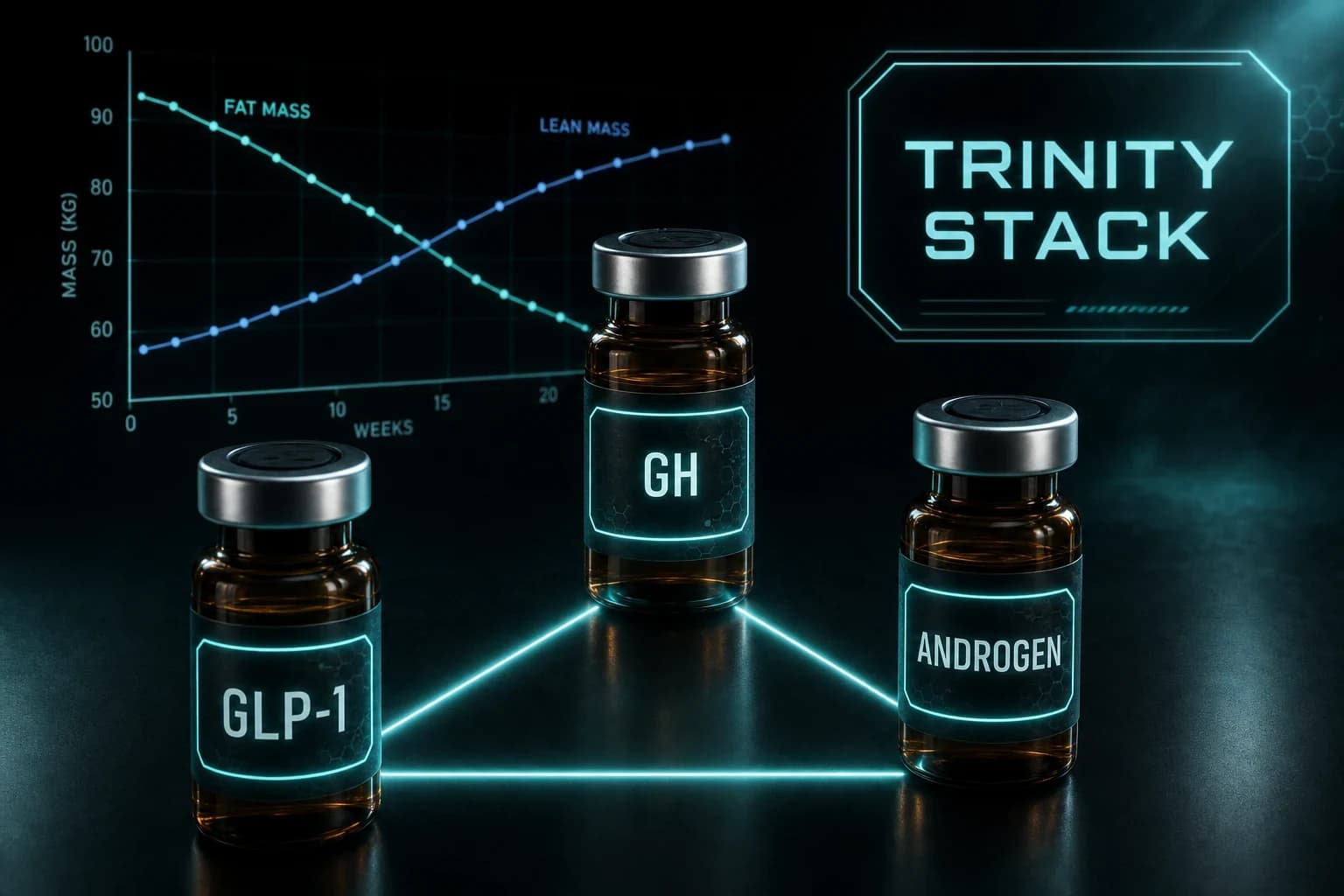
- Three levers: GLP-1 (fat loss) + GH secretagogue (recovery) + androgen modulation (muscle)
- GLP-1s cut 15-24% body weight but 25-40% of loss can be lean mass
- Pulsatile GHRH (tesamorelin) beats non-pulsatile MK-677, which raises glucose and causes edema
- Testosterone added 3.4-7.9 kg fat-free mass dose-dependently (Bhasin 2001)
- Stacking GH/IGF-1 with androgens compounds pro-growth tumor risk; requires medical supervision
Most viral physique transformations are not one drug. They are three levers pulled at once.
On the June 2026 Huberman Lab episode, Dr. Abud Bakri described the protocol behind a large share of modern body recompositions: a GLP-1 for fat loss, a growth-hormone secretagogue for recovery and body composition, and androgen modulation for muscle. He framed it as three levers. The internet calls it the celebrity stack. The mechanism is the same either way.
This is not a how-to-dose guide. It is an explainer of why these three sit together, what each one actually does to your body, what the evidence shows, and where the stacked risk lives. One of the three levers, androgen modulation, is hormone therapy. We do not sell it, and you should not run it without a physician. Read this as the map, not the prescription.
The logic: three levers, three problems
Fat loss, muscle, and recovery are not the same biological problem, and no single compound solves all three cleanly. That is the entire reason the stack exists.
A GLP-1 receptor agonist is the best fat-loss tool ever brought to market, but it pulls weight off everywhere, including muscle. A growth-hormone secretagogue improves sleep, connective-tissue repair, and body composition, but builds little muscle on its own. Androgen modulation builds and protects lean mass, but does nothing for appetite or visceral fat. Each lever covers a blind spot the other two leave open.
Run alone, each has a weakness. The GLP-1 dieter loses muscle along with fat. The GH-secretagogue user gets better sleep and skin but a barely-changed scale. The TRT patient holds muscle but still carries the same belly. Stacked, the theory goes, fat falls (GLP-1), the lost weight skews toward fat instead of muscle (androgen), and recovery keeps pace so training volume holds up (GH axis). Whether that is wise depends almost entirely on supervision and on which agents you pick for each lever.
Note: Bakri's framing is a description of what is already happening in the gray market and in concierge clinics, not an endorsement. He repeatedly anchored the conversation on the foundation first: morning sunlight, sleep, diet, and training are the floor. Peptides and hormones are additive only on top of that floor, never a substitute for it.
The three levers at a glance
| Lever | Mechanism | Example agents | Main benefit | Main risk |
|---|---|---|---|---|
| 1. GLP-1 (fat loss) | Agonizes GLP-1 (± GIP, glucagon) receptors: appetite suppression, slowed gastric emptying, improved insulin sensitivity | Semaglutide, tirzepatide, retatrutide | 15-24% total body-weight reduction in Phase 2/3 trials | Lean mass can be ~25-40% (up to 40-60%) of weight lost; GI side effects; rebound after stopping |
| 2. GH axis (recovery, body comp) | Stimulates endogenous GH release (GHRH analog) or mimics ghrelin (oral secretagogue), raising IGF-1 | Tesamorelin, sermorelin, CJC-1295/ipamorelin, MK-677 | Better deep sleep, connective-tissue repair, visceral-fat reduction, modest lean-mass gain | IGF-1 elevation (pro-growth tumor caveat), insulin resistance, fluid retention |
| 3. Androgen modulation (muscle) | Restores or raises testosterone (exogenous T) or blocks estrogen feedback to raise endogenous T (SERM) | TRT (testosterone), enclomiphene | Dose-dependent fat-free-mass and strength gains | HPTA suppression, infertility (TRT), hematocrit/lipid/prostate monitoring |
Read the table left to right and the stack logic falls out. Three different receptor systems, three different problems, three different risk ledgers. Now each lever in detail.
Lever 1: GLP-1 for fat loss (and the muscle it costs you)
GLP-1 receptor agonists are the most effective pharmacological fat-loss tools ever studied. The trial data is not subtle.
In STEP 1, once-weekly semaglutide 2.4 mg produced a mean 14.9% body-weight reduction over 68 weeks in 1,961 adults without diabetes, versus 2.4% on placebo (Wilding et al., NEJM 2021). SURMOUNT-1 pushed further: tirzepatide, a dual GLP-1/GIP agonist, hit 20.9% at the 15 mg dose across 2,539 participants over 72 weeks (Jastreboff et al., NEJM 2022). The triple agonist retatrutide (GLP-1 + GIP + glucagon) reached 24.2% at 48 weeks on the 12 mg dose in a 338-person Phase 2 trial (Jastreboff et al., NEJM 2023). Huberman called retatrutide a likely trillion-dollar product on the episode, and the slope of those numbers explains why.
Here is the catch that drives the whole stack. The scale does not distinguish fat from muscle, and neither does a GLP-1. A 2024 review of body-composition data found that lean mass made up roughly 15% to as much as 40-60% of total weight lost on GLP-1-based therapy, depending on the study, with a commonly cited middle estimate around 25-40% (Neeland et al., Diabetes Obesity Metabolism 2024). When you lose weight fast with sharply suppressed appetite, protein intake and resistance-training stimulus often drop at the same time, and the body sheds skeletal muscle alongside adipose tissue. For a 25-year-old chasing a physique, that is the opposite of the goal.
That single fact is the bridge to levers 2 and 3. The fat-loss engine is settled. The lean-mass leak is the problem the rest of the stack is built to plug. We cover the mechanism and the preservation research in the GLP-1 lean-mass loss breakdown, the triple-agonist mechanism on the retatrutide explainer, and the agent profile on the retatrutide research page.
Tip: The lean-mass loss on a GLP-1 is not fixed. Adequate protein (roughly 1.6 g/kg or higher), consistent resistance training, and the lowest effective dose all bend the fat-to-muscle ratio of the weight you lose. Bakri's own model is lowest effective dose plus real lifestyle change, then taper, not maximum dose indefinitely.
Lever 2: the GH axis (and why pulsatile beats a constant dump)
The second lever exists because growth hormone improves three things that matter to a recompositioning body: deep sleep, connective-tissue and muscle repair, and body composition (more visceral fat off, slightly more lean mass on). Almost nobody serious injects recombinant HGH for this anymore. The smarter approach raises your own GH, and the agents differ enormously in how they do it.
The single most important distinction is pulsatile versus non-pulsatile. Your pituitary naturally releases GH in pulses, mostly during slow-wave sleep, with low troughs between. That pulsatility is part of the safety design: feedback from somatostatin and IGF-1 keeps the system in check. A drug that respects the pulse behaves like your physiology. A drug that floods the receptor continuously does not.
Tesamorelin is the FDA-approved benchmark: a stabilized GHRH analog that triggers a clean, physiological GH pulse from your own pituitary. In its 412-patient Phase 3, it cut visceral fat 15.2% over 26 weeks while subcutaneous fat barely moved (Falutz et al., NEJM 2007). On the metabolic side, a 12-week trial in people with type 2 diabetes found no significant worsening of HbA1c or glycemic control at the 1-2 mg doses (Clemmons et al., PLoS One 2017). Full mechanism and dosing live in the tesamorelin visceral-fat guide.
Sermorelin, CJC-1295, and ipamorelin are the popular research-grade GHRH-plus-secretagogue family. Sermorelin and CJC-1295 are GHRH analogs; ipamorelin is a selective ghrelin-receptor agonist that adds a GH pulse without the cortisol or prolactin bump older secretagogues caused. They are typically stacked to hit the pituitary through two doors at once. The full comparison is on the sermorelin vs CJC-1295 vs ipamorelin breakdown.
MK-677 (ibutamoren) is the outlier, and the one Bakri singled out for its trade-offs. It is an oral ghrelin mimetic, which is its great convenience and its core problem. Instead of a pulse, MK-677 produces a large, sustained, non-pulsatile rise in GH and IGF-1. In healthy older adults, 25 mg daily for two years raised GH and IGF-1 into the young-adult range and added 1.1 kg of fat-free mass versus a 0.5 kg loss on placebo. It also raised fasting glucose by 0.3 mmol/L, decreased insulin sensitivity, and caused transient lower-extremity edema and muscle pain (Nass et al., Annals of Internal Medicine 2008). The upside is real sleep architecture improvement: an earlier crossover study found roughly a 50% increase in stage IV (deep) sleep and a 20-50% increase in REM (Copinschi et al., Neuroendocrinology 1997). The downside is exactly what a constant GH dump predicts: water retention and insulin resistance. The complete oral-secretagogue picture is in the MK-677 ibutamoren guide.
GH secretagogues compared
| Agent | Route | GH release pattern | Best-evidenced benefit | Notable downsides |
|---|---|---|---|---|
| Tesamorelin | Subcutaneous, daily | Pulsatile (GHRH analog) | 15.2% visceral fat reduction at 26 weeks (Falutz 2007); FDA-approved | IGF-1 rise, arthralgia, glucose monitoring |
| Sermorelin / CJC-1295 + ipamorelin | Subcutaneous, daily | Pulsatile (GHRH + ghrelin agonist) | Deep-sleep and recovery support; lower side-effect profile than older secretagogues | Less large-trial human data than tesamorelin; injection burden |
| MK-677 (ibutamoren) | Oral, daily | Non-pulsatile, sustained "dump" | +1.1 kg fat-free mass over 2 yr; ~50% more deep sleep (Nass 2008, Copinschi 1997) | Water retention, increased appetite, decreased insulin sensitivity, higher fasting glucose |
The pattern is hard to miss. The convenience of an oral comes at the cost of physiology. The injectable GHRH analogs cost you needles but keep the GH pulse, and tesamorelin alone carries an actual FDA approval and a clean 412-patient dataset behind it.
Lever 3: androgen modulation (the lever we do not sell)
Muscle is the third problem, and androgens are the most direct answer to it. This lever is also where the stack stops being a peptide question and becomes a hormone-therapy question that belongs in a clinic.
The dose-response evidence is unusually clean. Bhasin and colleagues gave 61 healthy young men graded weekly doses of testosterone (25 to 600 mg) for 20 weeks while suppressing their own production. Fat-free mass rose in lockstep with dose: +3.4, +5.2, and +7.9 kg in the 125, 300, and 600 mg groups, with leg strength and muscle volume tracking testosterone concentration and fat mass falling (Bhasin et al., Am J Physiol Endocrinol Metab 2001). That is the muscle lever, quantified. It is also why a GLP-1 dieter who is androgen-replete loses less muscle: testosterone is anti-catabolic, so it biases the weight you lose toward fat.
Two common forms, two different trade-offs.
TRT (exogenous testosterone) raises serum testosterone directly and reliably. The cost is that your body reads the external supply as a signal to stop making its own. Luteinizing hormone and follicle-stimulating hormone fall, the testes downregulate, and the hypothalamic-pituitary-testicular axis (HPTA) is suppressed. The practical consequences: testicular atrophy and, importantly for younger men, impaired fertility. TRT also requires monitoring of hematocrit, estradiol, lipids, and prostate (PSA).
Enclomiphene works from the opposite direction. It is a selective estrogen receptor modulator that blocks estrogen's negative feedback at the hypothalamus, so your brain ramps up LH and FSH and your testes make more of their own testosterone. Because it works through your own axis rather than overriding it, it tends to preserve testicular function and fertility better than exogenous testosterone. It is not a free lunch: response varies, and it is still a prescription hormone-pathway drug that needs bloodwork.
We do not sell either one, and that is deliberate. TRT and enclomiphene are physician-managed hormone therapies with real suppression, fertility, and cardiovascular monitoring requirements. If muscle is the lever you are trying to pull, the correct move is a doctor and a lab panel, not a checkout cart. For the related question of keeping your own axis online during therapy, see the gonadorelin and HPTA fertility evidence.
The combined rationale, and the stacked risk
Put the three together and the appeal is obvious. GLP-1 strips fat, androgen modulation skews the lost weight toward fat while protecting muscle, and the GH axis supports the sleep and connective-tissue recovery that lets training intensity hold through a calorie deficit. On paper, the levers cover each other's blind spots.
The risk does not add. It compounds. Each lever carries its own ledger, and two of them push in a direction that genuinely worries clinicians when combined.
Growth hormone and IGF-1 are pro-growth signals: they tell tissue to proliferate. That is the entire point for muscle and connective tissue, but proliferation is indiscriminate, and if an undiagnosed malignancy is present, an elevated IGF-1 environment is theoretically the wrong one to create. This is not a casual hypothetical. Huberman has described trying sermorelin for better deep sleep and stopping after a PSA rise. Androgens add to the picture, because testosterone is a recognized driver of prostate tissue, which is precisely why PSA monitoring is non-negotiable on TRT. Stack a GH secretagogue on top of androgen therapy and you have layered two pro-growth signals at once.
Warning: GH/IGF-1 elevation and androgen therapy are both pro-growth signals, and stacking them compounds rather than averages the theoretical risk of accelerating an undiagnosed tumor (prostate being the textbook concern). This is the single biggest reason this stack belongs under medical supervision with baseline and periodic labs (IGF-1, PSA, hematocrit, HbA1c, lipids, estradiol), not run blind off gray-market vials. If a marker moves the wrong way, the protocol changes. You cannot catch what you do not measure.
The other two ledgers are quieter but real. The GLP-1 lean-mass leak undercuts the very muscle the androgen lever is trying to build, so dose and protein discipline matter. The GH axis, especially MK-677, can worsen insulin sensitivity at the same time the GLP-1 is trying to improve it, a genuine push-pull on glucose control worth tracking. And the androgen lever's HPTA suppression makes fertility planning a before-the-first-injection decision, not an afterthought.
To see the recovery side built as a standalone protocol without the hormones, the Fit Stack shows the GH-secretagogue logic on its own. The half-life calculator models how long any injectable stays active when you layer compounds.
So is the trinity stack worth it?
For most people, the foundation does more than the stack, and the stack without supervision does more harm than the marketing admits.
If you are lean-mass-conscious and already on a medically supervised GLP-1, the strongest evidence-backed additions protect muscle and recovery: adequate protein, resistance training, and possibly a pulsatile GH secretagogue, monitored. The androgen lever should only enter through a physician already managing your hormones and tracking the labs. That is the difference between a recomposition protocol and a problem.
The viral transformations are real. So is the supervision behind the responsible versions, and so is the stacked-risk reality behind the rest.
Frequently Asked Questions
Why combine a GLP-1, a GH secretagogue, and an androgen instead of just using one?
Because they solve three different problems. A GLP-1 drives fat loss but costs lean mass (25-40% of weight lost can be muscle). Androgen modulation builds and protects muscle but does nothing for appetite. A GH secretagogue supports sleep, recovery, and visceral-fat loss but builds little muscle alone. Stacked, the theory is that fat falls while the lost weight skews toward fat instead of muscle, and recovery holds. The trade-off is that the risks compound, which is why supervision is the whole game.
Is MK-677 better than tesamorelin or sermorelin for the GH lever?
It depends on what you weigh more: convenience or physiology. MK-677 is oral and produces a large sustained GH/IGF-1 rise, with real deep-sleep benefit (Copinschi et al. 1997) but also water retention, increased appetite, and decreased insulin sensitivity (Nass et al. 2008). Tesamorelin and the sermorelin/CJC-1295/ipamorelin family are injectable but produce a pulsatile GH release that mirrors physiology, and tesamorelin is the only one with FDA approval and a 412-patient Phase 3 behind it.
What is the difference between TRT and enclomiphene for the muscle lever?
TRT supplies testosterone from outside, which works reliably but suppresses your own production, shrinks the testes, and impairs fertility. Enclomiphene is a SERM that blocks estrogen feedback so your own pituitary raises LH and FSH and your testes make more of their own testosterone, which tends to preserve fertility better. Both are prescription hormone therapies requiring bloodwork, and Peptides:Enhanced does not sell either one.
What is the biggest risk of running all three levers together?
Stacked pro-growth signaling. Both GH/IGF-1 and androgens promote tissue growth, and combining them theoretically raises the concern of accelerating an undiagnosed tumor, the prostate being the classic example (PSA monitoring is mandatory on TRT, and Huberman has described stopping sermorelin after a PSA rise). Add the GLP-1's lean-mass loss and MK-677's hit to insulin sensitivity, and several markers must be measured at baseline and tracked. This is why the stack belongs under medical supervision, not run blind.
Does Peptides:Enhanced sell the androgen part of this stack?
No. TRT (testosterone) and enclomiphene are physician-managed hormone therapies with suppression, fertility, and cardiovascular monitoring requirements, and they are not something we sell. The GH-secretagogue peptides discussed here (sermorelin, CJC-1295, ipamorelin, tesamorelin) are available from Ascension Peptides with 50% off using code ENHANCED, but the muscle/androgen lever should be set up through a doctor and a lab panel.
This article is for educational and research purposes only and is not medical advice. It analyzes the rationale and risks of a discussed protocol; it is not a recommendation to use any of these compounds. GLP-1 agonists and growth-hormone-axis peptides discussed here are largely investigational or used outside their approved indications. Androgen therapies (TRT, enclomiphene) are prescription hormone treatments that require physician management and laboratory monitoring. Consult a qualified healthcare professional before making any decisions about peptides, hormones, or any of the compounds discussed.