At a glance
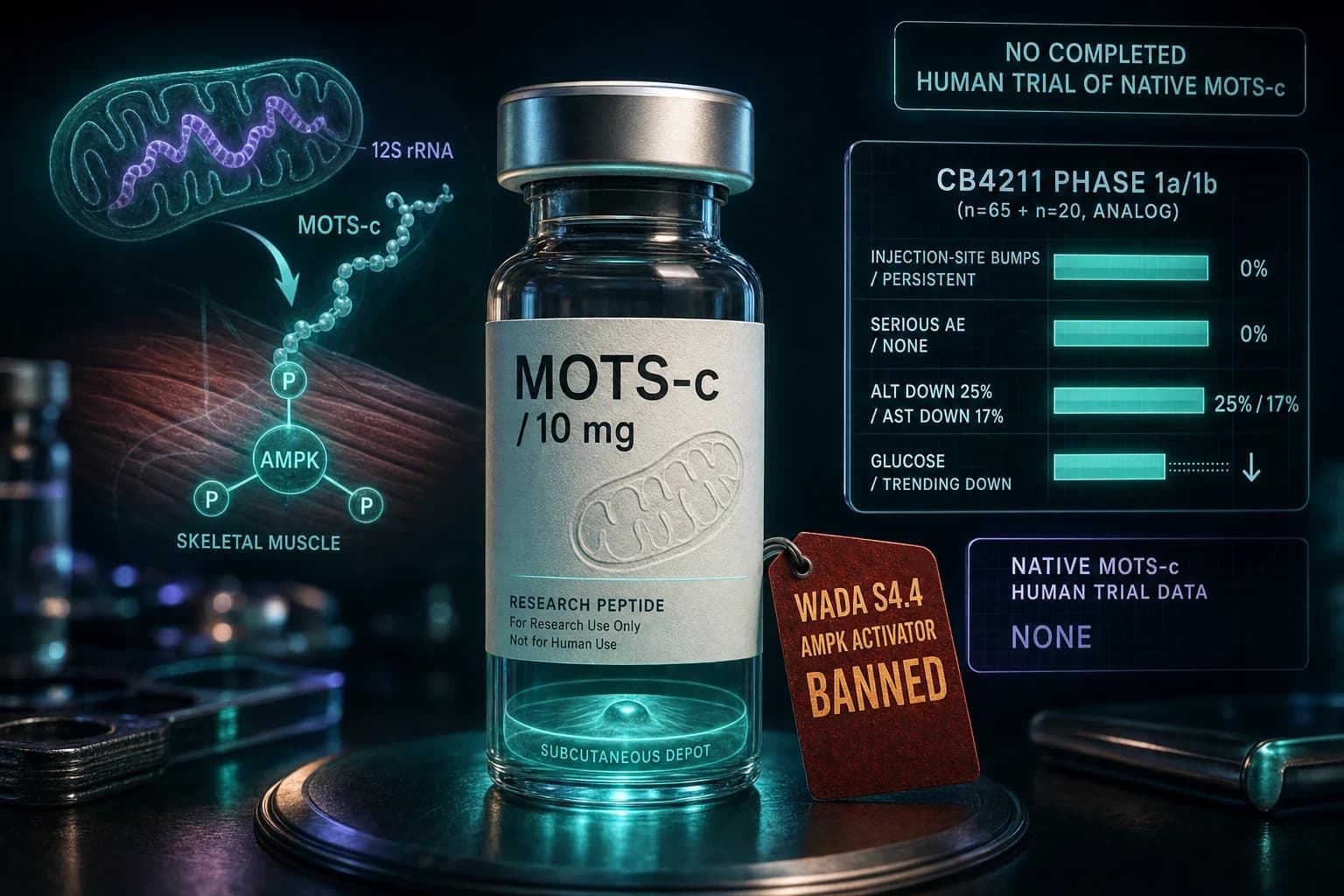
- No completed human trial has dosed native MOTS-c. All human safety data comes from CB4211, a CohBar analog.
- CB4211 phase 1a/1b in obese NAFLD patients at 25 mg SC daily for 28 days: no serious adverse events, but persistent painless injection-site bumps forced a 2018 trial suspension.
- AMPK activation drives the main real-world risk: additive hypoglycemia when MOTS-c is stacked with GLP-1s, insulin, or sulfonylureas.
- MOTS-c is banned in and out of competition under WADA S4.4 as an AMPK activator (USADA 2024 guidance).
- Community reports cluster around mild injection-site redness, first-week fatigue, and appetite drop. Long-term human safety data does not exist.
Most articles on MOTS-c side effects quietly conflate two very different datasets: the CB4211 phase 1 trial that CohBar ran in humans, and the native MOTS-c preclinical work that lives almost entirely in rodents and cell culture. Those are not interchangeable. CB4211 is a stabilized MOTS-c analog with a modified sequence; native MOTS-c has never been dosed in a completed human clinical trial.
This piece grades every commonly repeated MOTS-c side effect against the evidence that actually supports it: what the CB4211 trials showed, what native MOTS-c produced in animals, what community self-reports cluster around, and what the pharmacology predicts when it is layered on top of a GLP-1 or insulin regimen. If a claim about MOTS-c safety cannot be traced to a source, it does not belong in a safety article.
Where MOTS-c human safety data actually comes from
The FDA's 2026 landscape review of experimental peptides found no completed clinical trial in which participants received a MOTS-c drug. The one usable human dosing dataset is a phase 1a/1b program CohBar ran between 2018 and 2021 for CB4211, a chemically modified MOTS-c analog developed as a first-in-class mitochondrial-derived peptide therapeutic for NASH and obesity. Everything else circulating online is extrapolation from rodents, self-experiment community reports, or vendor copy that treats CB4211 data as if it were native peptide data.
| Evidence source | Strength | What it says about MOTS-c side effects |
|---|---|---|
| CB4211 Phase 1a, n=65 healthy adults, single- and multiple-ascending dose | Direct human (analog) | Generally well tolerated, no serious adverse events, persistent painless injection-site bumps forced 2018 suspension |
| CB4211 Phase 1b, n=20 obese NAFLD, 25 mg SC daily x 28 days | Direct human (analog) | No serious AEs, ALT down 25%, AST down 17%, glucose trend down; program later discontinued for formulation reasons |
| Ramanjaneya et al. 2019 Clin Endocrinol (PMID 31066084), n=22 | Human observational | MOTS-c is measurable in serum; no adverse-event endpoint, no injection exposure |
| Lee et al. 2015 Cell Metab (PMID 25738459) | Rodent + in vitro | No organ toxicity reported at doses that reduced diet-induced obesity |
| Reynolds et al. 2021 Nat Commun (PMID 33473109) | Rodent | 5 and 15 mg/kg/day IP; late-life 3x/week regimen improved physical capacity, no toxicity signal |
| Kim et al. 2019 Physiol Rep (PMID 31293078) | Rodent metabolomics | Insulin sensitivity up, plasma metabolites altered, no adverse-event framework |
| Kumagai et al. 2021 AJP-EM (PMID 33554779) | Rodent + in vitro | Myostatin down, no atrophy signal, no toxicity endpoint |
| Community reports (forums, subreddits) | Anecdotal | Directional only; useful for tolerability wording, not for causal claims |
That is the honest evidence base. When a peptide vendor tells you MOTS-c is "generally well tolerated at 5-10 mg subcutaneously," they are extrapolating from the CB4211 analog's 25 mg SC daily trial and from community self-reports. There is no controlled human safety trial of native MOTS-c on record.
The CB4211 injection-site story most articles skip
CohBar's clinical program is the closest thing to a human side-effect signal MOTS-c has, and the most important finding is the one that briefly derailed the trial.
In November 2018, CohBar disclosed a temporary voluntary suspension of the CB4211 phase 1 study to address "mild injection-site reactions that have been unexpectedly persistent." In the same SEC filing and subsequent BioSpace release, the company described them as painless bumps under the skin, in most cases only detectable by palpation, but persisting for weeks. The working hypothesis was that some fraction of each subcutaneous dose remained at the injection site rather than being fully cleared into circulation.
The trial was reformulated, protocol amended, and phase 1a resumed and completed in 2019. Phase 1b, dosing 20 patients with obesity and NAFLD at 25 mg SC daily for 28 days, wrapped in 2021 with no serious adverse events and modest signals on ALT, AST, glucose, and weight. CohBar then found the phase 1b formulation was not suitable for further development, could not produce an improved version, and by 2022 disclosed in its Form 10-K that it was exploring strategic alternatives. The CB4211 program was discontinued before a phase 2 program began.
That entire history is the human safety database for a MOTS-c-class peptide. It is real, it is publicly disclosed, and every honest MOTS-c safety article should cite it.
Bottom line: The strongest human safety claim available is this: a stabilized MOTS-c analog at 25 mg SC daily for 28 days in obese adults caused no serious adverse events and produced persistent, painless, subcutaneous bumps consistent with local depot persistence. Extrapolating that to indefinite 5-10 mg native MOTS-c use is a jump the CB4211 dataset does not justify.
What community reports actually cluster around
Native MOTS-c is bought as a "for research purposes only" lyophilized peptide and reconstituted for subcutaneous injection at 5 to 10 mg two or three times per week. That protocol has never been formally tested. What community reports across forums, subreddits, and vendor comment threads consistently describe:
- Injection-site redness or a firm subcutaneous bump. The most common finding across every source. Mild, self-limiting, usually gone within 24 to 48 hours, occasionally persisting as the painless bumps CohBar characterized in CB4211.
- First-week fatigue. A "flat" or "hungover" feeling in the first three to five doses, often described as blunted energy or brain fog. Plausible as an AMPK-mediated metabolic recalibration effect. Usually resolves.
- Appetite drop. A mild appetite-suppressant effect during the first two weeks. Often desirable in weight-focused protocols; occasionally uncomfortable in muscle-focused ones.
- Reactive hypoglycemia symptoms. Lightheadedness, sweating, hunger swings, especially in users running MOTS-c alongside fasted training, low-carb diets, or other glucose-lowering compounds.
- Palpitations and insomnia. Reported less frequently. Both are self-limited in the reports but should push you to hold and reassess if they escalate.
None of that constitutes evidence-grade safety data. It is user experience, and the mix of vials, doses, reconstitution quality, and stacking behavior across community reports makes causal attribution to MOTS-c itself difficult. Almost every serious side-effect thread comes with a story about who they bought from and how they mixed it, and that is not a coincidence. Independent lab verification of the vial before dosing (identity, purity, endotoxin) does more to reduce reported side effects than any dose adjustment, which is why our lab-tests library exists and why we treat sourcing as a safety question, not a marketing one.
AMPK activation and the real hypoglycemia risk
The one mechanism-driven safety signal that matters for the site's actual reader base is glycemic. MOTS-c activates AMP-activated protein kinase (AMPK) in skeletal muscle, drives insulin-independent glucose uptake, and mimics several exercise-induced signaling effects (Lee et al. 2015; Kim et al. 2019). In lean rodents at physiologic doses, this manifests as improved insulin sensitivity, not frank hypoglycemia. Stack the same mechanism on top of a pharmacologic glucose-lowering agent and the math changes.
Practical implication: anyone running MOTS-c alongside compounded semaglutide, tirzepatide, retatrutide, insulin, sulfonylureas, or an SGLT2 inhibitor should treat the combination as inherently additive on the glycemic axis. The CB4211 phase 1b program specifically tracked glucose and showed a downward trend in obese subjects at 25 mg SC daily, and that trend is exactly what you would expect the mechanism to do. In a patient already on a GLP-1, the residual hypoglycemia headroom is smaller, and symptoms (sweats, lightheadedness, palpitations, hunger rebound) will show up faster.
The site's GLP-1 dosing comparison guide covers where the incretin analog dose ceilings sit; the MOTS-c dosage chart covers the reconstitution and dose math for the peptide side. Neither replaces glucose monitoring during the stack.
Warning: If you are on any glucose-lowering prescription (GLP-1, insulin, sulfonylurea, metformin, SGLT2), do not add MOTS-c without a physician's involvement and a plan for glucose monitoring. AMPK activators are on the WADA prohibited list specifically because they alter metabolic substrate handling; layering them on a pharmacologic agent that already does the same thing is not a peptide question, it is a drug-interaction question.
Preclinical safety signals from rodent work
Native MOTS-c has been dosed extensively in rodents, and the toxicity picture is quiet across the published record. In the foundational 2015 Lee paper, MOTS-c at 5 mg/kg/day IP for 7 to 8 weeks in high-fat-diet mice reduced adiposity without organ toxicity, weight loss beyond the intended metabolic effect, or immune adverse events. Reynolds et al. dosed 5 and 15 mg/kg/day for up to 10 days and a late-life intermittent 3x/week regimen from 23.5 months of age, with no toxicity signal and clear improvements in running capacity and grip strength (Reynolds et al. 2021). Kim et al. 2019 profiled plasma metabolites in MOTS-c-injected mice and reported reductions in sphingolipid, monoacylglycerol, and dicarboxylate metabolism pathways associated with insulin resistance, again with no reported adverse events at study doses (Kim et al. 2019).
The absence of a signal in rodents is meaningful but limited. Mouse studies do not resolve long-term human cancer risk, immunogenicity of a chronically injected peptide, or interaction effects with the polypharmacy pattern the human MOTS-c user base actually presents with. The direct-evidence table above is a floor, not a ceiling.
MOTS-c on the WADA prohibited list
MOTS-c is banned at all times, in and out of competition, under WADA section S4.4 (Metabolic Modulators), sub-category S4.4.1 (Activators of AMPK). USADA's 2024 guidance explicitly names MOTS-c as a prohibited AMPK activator and warns athletes away from experimental peptides sold under "for research purposes only" labels.
For a tested athlete, this is the single largest and most immediate MOTS-c side effect. A positive test carries the same competitive consequences as any other prohibited compound in its class. Because MOTS-c is unapproved for any human indication, a Therapeutic Use Exemption is essentially unavailable. The 2024 WADA classification change codified this rather than creating it; the practical status has been the same since 2019, when AMPK activators were first named as examples in the metabolic modulator section.
Non-athletes are not exempt from every legal question this raises. State medical boards and telehealth compliance rules treat experimental unapproved peptides differently across states, and vendors selling MOTS-c to consumers rather than to bona fide research institutions operate in a documented gray zone. That is a separate topic; the gray-market peptide sourcing guide covers the regulatory context.
Drug interactions and who probably should not touch it
Absent a formal human trial, the interaction analysis has to run through pharmacology. Compounds and conditions that increase the risk profile of a MOTS-c protocol:
| Interacting compound or state | Why it matters | Practical implication |
|---|---|---|
| GLP-1 receptor agonists (semaglutide, tirzepatide, retatrutide) | Additive glycemic and appetite effects | Higher hypoglycemia and nausea risk; monitor glucose |
| Insulin or sulfonylureas | Overlapping glucose-lowering mechanism | Hypoglycemia risk elevated; do not combine without physician |
| SGLT2 inhibitors, metformin | AMPK-adjacent mechanism | Additive metabolic signaling; monitor closely |
| Prolonged fasting or ketogenic protocols | Glycogen already low, glucose already low | Reactive hypoglycemia risk higher; expect fatigue |
| Anti-hypertensives, vasodilators | Anecdotal flushing/palpitation reports | Watch for orthostatic symptoms in first week |
| Pregnancy or breastfeeding | No safety data at all | Absolute contraindication |
| Active malignancy or history of hormone-sensitive cancer | AMPK signaling intersects with tumor metabolism ambiguously | Absolute contraindication outside research settings |
| Untreated adrenal insufficiency, uncontrolled endocrine disease | Metabolic reserve compromised | Absolute contraindication |
MOTS-c has not been formally tested against any of these interactions. The table is mechanism-based, not trial-derived. That is the exact reason the risk-reward calculus should be conservative: absence of evidence for an interaction is not evidence of absence, and the AMPK axis is upstream of enough pathways that "we do not know" is the honest description of the safety envelope.
What to actually monitor and when to stop
For research protocols that proceed anyway, the following objective checks are the minimum useful set.
Before starting:
- Baseline fasting glucose, HbA1c, and a basic metabolic panel.
- Baseline body weight, resting heart rate, and morning blood pressure.
- Independent COA for the specific vial and lot (peptide identity, HPLC purity at 98% or higher, LAL endotoxin below assay threshold).
During weeks 1 to 4:
- Daily symptom log: injection-site bumps, energy, sleep, appetite, palpitations, lightheadedness.
- Fasting glucose spot checks two or three mornings per week if stacking with any glucose-lowering agent.
- Rotate injection sites (abdomen, quadriceps, deltoid) to avoid layering doses in the same subcutaneous tissue.
Stop and reassess if any of the following occur:
- Persistent painless bumps that do not resolve within two weeks (mirrors the CB4211 finding).
- Any signs of true hypoglycemia (sweats, tremor, confusion, syncope), especially when stacked with a GLP-1 or insulin.
- New or worsening palpitations, chest discomfort, or exertional shortness of breath.
- Rash, generalized itching, throat tightness, or any sign of a hypersensitivity reaction (rare in community reports, but treat as absolute stop).
- Unexplained changes in liver enzymes, fasting glucose trending outside expected direction, or new hyperglycemia symptoms.
The reconstitution calculator and the reconstitution guide handle the concentration math, which removes a common source of "side effects" that are actually dosing errors from underdiluted vials.
Compared to other mitochondrial and metabolic peptides
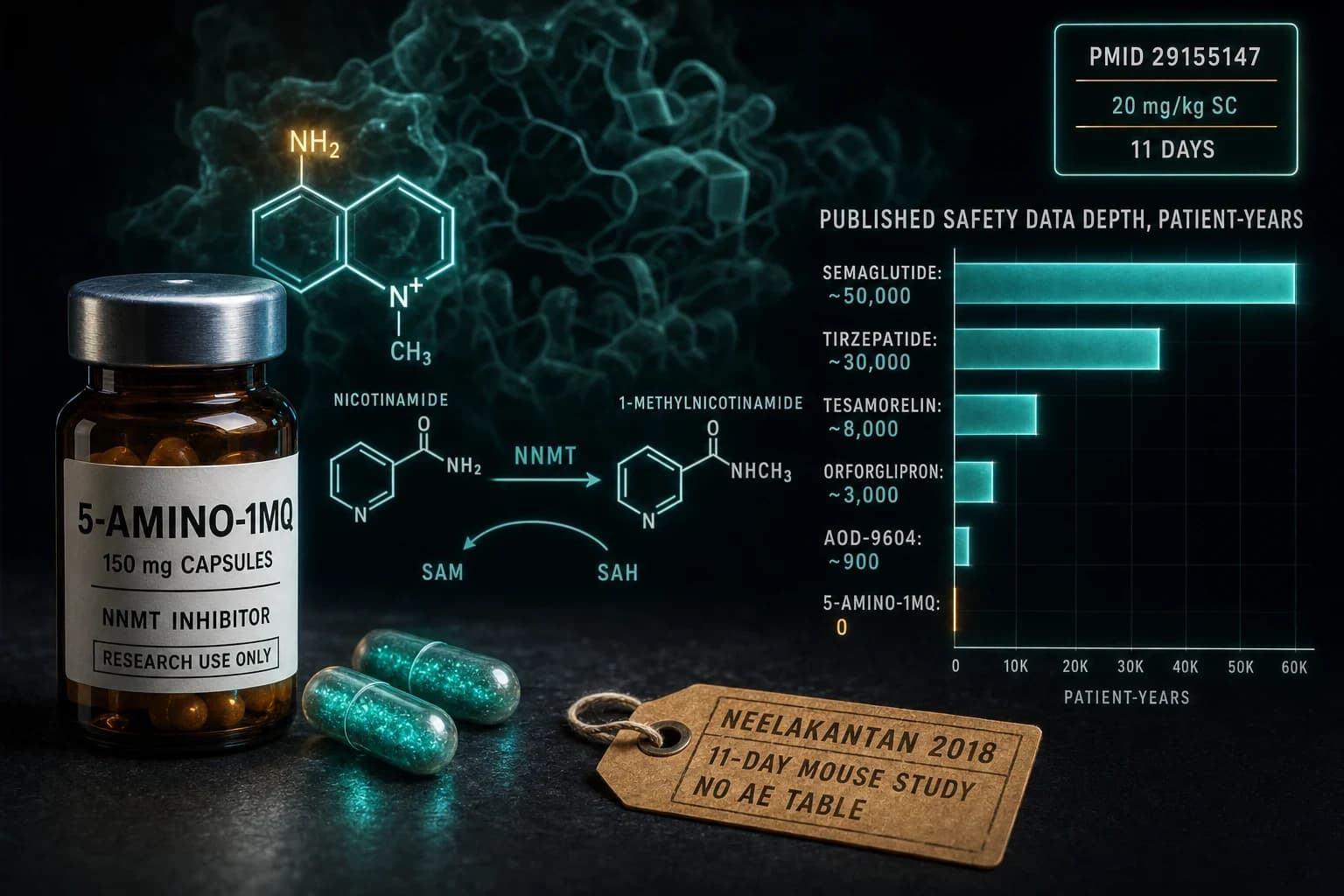
Placing MOTS-c inside its adjacent class puts the safety picture in context. SS-31 (elamipretide) is the only mitochondrial-targeted peptide with FDA approval (for Barth syndrome), and its safety database is orders of magnitude larger. 5-Amino-1MQ targets NNMT and shares the metabolic-modulator conceptual family, with an even thinner human safety record. NAD+ is a coenzyme rather than a peptide and its injection safety is dominated by administration effects rather than mechanism-of-action risk. For a broader map of the class, the mitochondrial peptide comparison walks through how SS-31 and MOTS-c address different parts of mitochondrial dysfunction.
That comparison matters for a side-effects article because the class as a whole has one shared truth: preclinical benefit is well characterized, human safety data is uneven, and injection-site plus glycemic signals dominate what people actually experience.
Sourcing quality is a safety question
A meaningful share of what gets reported as "MOTS-c side effects" is a side effect of the vial. Underdosed lyophilizate, endotoxin contamination, mislabeled sequences, and non-sterile reconstitution water all produce local and systemic reactions that get misattributed to the peptide itself. That is not a hypothetical: the gray-market peptide sourcing analysis and the Ascension Peptides vendor audit exist because the difference between a lot with a real COA and a lot without one is the difference between a peptide article and a contamination article.
The minimum acceptable sourcing standard for anyone taking peptide safety data seriously: an independent HPLC identity, mass spec confirmation, and LAL endotoxin test per lot, at 98% or higher purity. Below that bar, no side-effect profile is interpretable.
Injectable research peptides including MOTS-c, SS-31, 5-Amino-1MQ, and NAD+ are available from Ascension Peptides with 50% off using code ENHANCED, with per-lot COAs published. For dose calibration, the MOTS-c dosage chart and the reconstitution calculator remove the arithmetic errors that show up as "side effects" in first-time protocols.
Bottom line
Bottom line: Native MOTS-c has never completed a human safety trial. The best available human dataset is CB4211, an analog CohBar dosed at 25 mg SC daily for 28 days, which produced no serious adverse events but forced a 2018 pause for persistent painless injection-site bumps and was later discontinued for formulation reasons. Community reports on native MOTS-c cluster around mild injection-site reactions, first-week fatigue, appetite suppression, and reactive hypoglycemia when stacked with GLP-1s or insulin. WADA prohibits it as an AMPK activator in and out of competition. Long-term human safety is unknown, and any protocol that pretends otherwise is selling something.
For the full mechanism and use-case background, see the MOTS-c compound page and the MOTS-c research guide. For dose math and reconstitution, the MOTS-c dosage chart is the reference. For the sourcing standards that determine whether any of the above matters, the Ascension Peptides vendor audit is the primary trust reference on this site.
This article is for research and educational purposes only. It is not medical advice, and no content here should be used to diagnose, treat, or prevent any condition. MOTS-c is not approved by the FDA for human use and is prohibited by WADA under S4.4 as an AMPK activator. Consult a qualified physician before making any decisions related to peptides, hormones, or health.