At a glance
- Bioregulators are 2-4 amino acid peptides Khavinson says bind DNA to shift gene expression
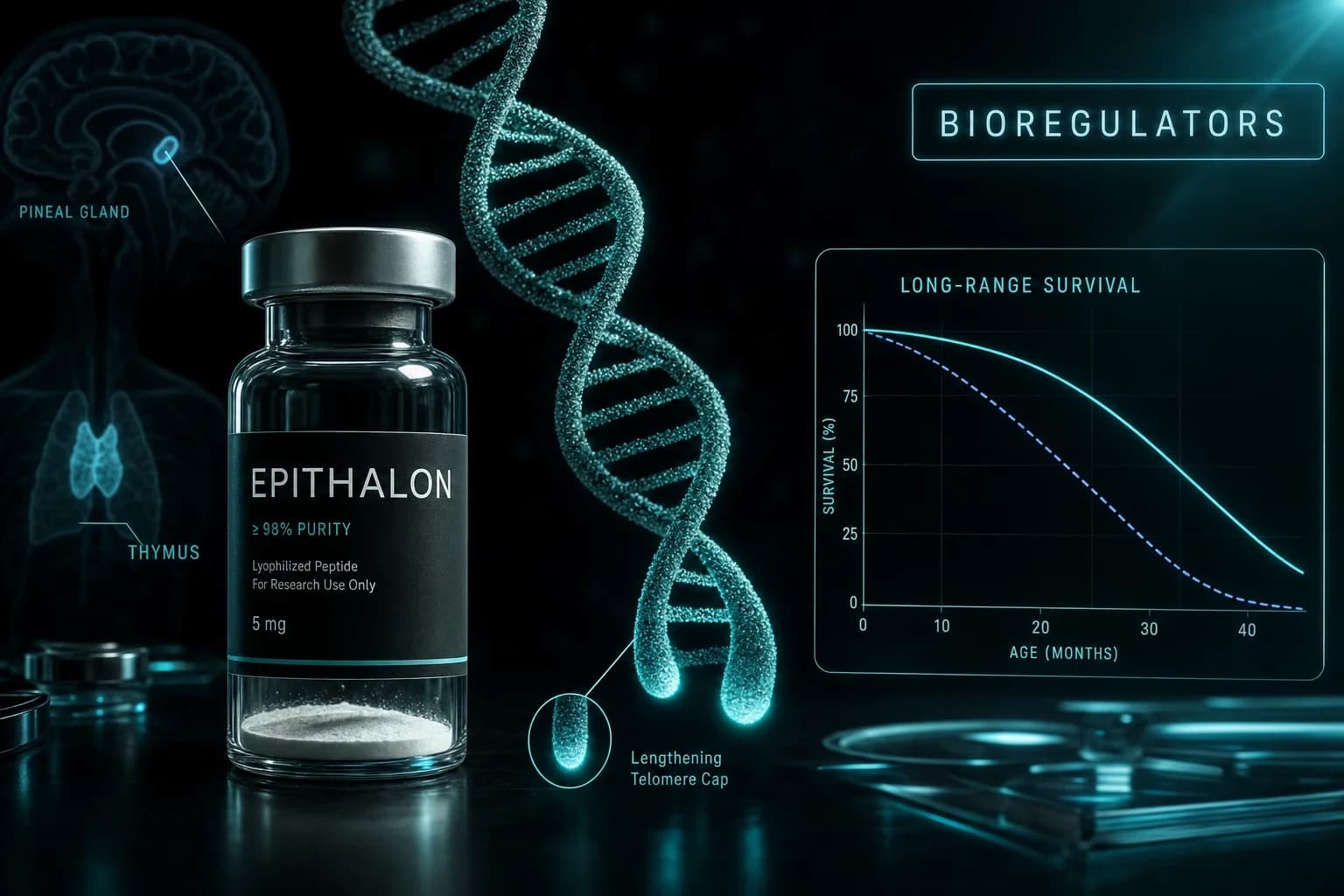
- Epithalon (AEDG) reactivated telomerase in human fibroblasts (Khavinson 2003)
- 266-subject cohort, 6-8 yrs: mortality cut up to 4.1x with thymalin + epithalamin (Khavinson 2003)
- Epitalon added 12.3% to max lifespan in mice but not mean (Anisimov 2003)
- Nearly all data is Russian, small-n, under-replicated in the West
On the June 2026 Huberman Lab episode, Dr. Abud Bakri described a class of peptides that supposedly does something no GLP-1 or BPC-157 claims to do: reset gene expression so the benefit outlasts the dose. Stop the peptide, keep the effect. That is the "bioregulator" thesis, and it traces back almost entirely to one man.
Vladimir Khavinson ran the St. Petersburg Institute of Bioregulation and Gerontology for decades and published a body of work on very short peptides (2 to 4 amino acids) that he argued penetrate the cell nucleus, bind specific DNA promoter regions, and switch tissue-specific genes on or off. Epithalon, pinealon, thymalin, and a dozen named cousins all come from this program. The longevity claims attached to them are genuinely striking, including a multi-year human cohort reporting a 4.1-fold drop in mortality.
This is a class-level piece. We already have dedicated guides for the individual compounds (epithalon, pinealon, thymosin alpha-1), so the goal here is the connecting story plus the honest critique: where the evidence is real, where it is thin, and what a skeptic should actually conclude.
What a "bioregulator" peptide actually is
A bioregulator, in Khavinson's framework, is a short peptide that regulates the function of a specific tissue. The core hypothesis has three steps:
- Each organ produces its own short signaling peptides that regulate its gene expression.
- Those peptides decline with age, so the tissue's repair and protein synthesis slow down.
- Re-supplying the matching peptide restores more youthful gene expression in that tissue.
Khavinson's group organized these into a taxonomy that is worth knowing, because vendors blur the categories:
- Cytomaxes: natural peptide complexes extracted from young animal organs (typically calf tissue). Each contains a mixture of short peptides from that organ. Thymalin (thymus) and epithalamin (pineal) are the original cytomax preparations used in the human studies below.
- Cytogens: synthetic single-sequence peptides reverse-engineered from the most active fragment in a cytomax. Epithalon (Ala-Glu-Asp-Gly) is the synthetic cytogen derived from epithalamin; pinealon (Glu-Asp-Arg) is another.
- Cytamins: oral tablet preparations of organ peptide complexes.
That distinction matters for reading the literature. The famous human mortality data used the natural extracts (thymalin and epithalamin). The famous telomerase data used the synthetic tetrapeptide (epithalon). They are related but not identical compounds, and the marketing tends to credit the synthetic peptide with results that came from the extract.
Note on terminology: "Epithalon" and "epitalon" are the same synthetic tetrapeptide; "epithalamin" is the natural pineal extract it was derived from. We keep the spelling each study actually used.
The "reset gene expression, keep the benefit" thesis
This is the part that makes bioregulators interesting and the part that earns the most skepticism. Standard receptor agonists work while they occupy the receptor and stop when they clear. Khavinson's claim is categorically different: the peptide changes which genes a cell transcribes, and that altered expression state persists after the peptide is gone.
The proposed mechanism is direct peptide-DNA binding. Ashapkin et al. (2015), a review from the Khavinson group, argues that age-related loss of DNA methylation exposes binding sites, that short peptides bind those demethylated promoter regions, and that this binding regulates transcription and shields the region from endonuclease cleavage. In their model, the peptide acts as an epigenetic switch rather than a transient signal.
Here is the honest read. Sequence-specific DNA recognition by a 2-to-4-residue peptide is biochemically unusual. Real transcription factors use large folded domains to read DNA with specificity; a tripeptide has very little structure to work with. The Khavinson group has published binding and modeling work supporting it, but independent Western structural biology has not broadly validated the mechanism. So the "keep the benefit" thesis rests on a mechanism that is plausible in their hands and unproven outside them.
Epithalon and telomerase activation
The single most-cited bioregulator result is telomerase activation by epithalon. Telomerase rebuilds the telomere caps that shorten every time a cell divides; switching it back on in somatic cells could, in theory, extend a cell's replicative lifespan.
Khavinson et al. (2003) added epithalon to telomerase-negative human fetal fibroblasts and reported induction of the hTERT catalytic subunit, measurable telomerase enzyme activity, and telomere elongation. In a cell line that normally has no telomerase, that is a real and specific finding.
The caveats are equally specific. This is a cell-culture result from the originating lab, in fetal fibroblasts, not a demonstration that injecting epithalon lengthens telomeres in a living human. Re-expressing telomerase is also the same trick most cancers use to become immortal, which is exactly why uncritical "telomerase activation equals longevity" framing is naive. The deeper walkthrough of the telomere data lives in our epitalon telomerase activation research piece.
The rodent longevity data (Anisimov)
Vladimir Anisimov, an oncogerontologist who collaborated with Khavinson, ran the cleaner animal experiments, and they are more measured than the marketing suggests.
Anisimov et al. (1992) gave old rats the pineal extract epithalamin and reported higher pineal and serum melatonin alongside lifespan effects, tying the bioregulator story to melatonin and circadian function.
The synthetic peptide was tested directly in Anisimov et al. (2003): 54 female SHR mice per group received about 1.0 microgram per mouse (roughly 30 to 40 micrograms per kilogram) of epitalon on 5 consecutive days each month for life. The results are a useful reality check. Epitalon did not change mean lifespan. It did increase the lifespan of the last 10% of survivors by 13.3% and maximum lifespan by 12.3%, cut chromosome aberrations in bone marrow by 17.1%, and reduced leukemia incidence 6-fold. So the honest rodent headline is "slows some aging markers and extends maximum but not average lifespan," not "makes animals live dramatically longer."
The human cohort mortality claims
This is the evidence that makes people sit up, and the evidence that most needs scrutiny.
Khavinson and Morozov (2003) reported on 266 elderly subjects followed for 6 to 8 years. The peptide groups received thymalin, epithalamin, or both, given only during the first 2 to 3 years of observation (note the "keep the benefit" framing built into the design). The reported mortality reductions versus untreated controls:
- Thymalin: 2.0 to 2.1-fold lower
- Epithalamin: 1.6 to 1.8-fold lower
- Thymalin plus epithalamin: 2.5-fold lower
- A subgroup given thymalin plus epithalamin annually for 6 years: 4.1-fold lower mortality
Acute respiratory disease incidence also fell 2.0 to 2.4-fold. Two later randomized studies from the Kiev gerontology group extended the picture. Korkushko et al. (2006) ran a 12-year study of epithalamine in elderly coronary patients with accelerated cardiovascular aging and reported 28% lower total mortality and roughly 2-fold lower cardiovascular mortality versus controls on the same baseline therapy. Korkushko et al. (2011), a 15-year follow-up, treated 39 coronary patients with epithalamin (6 courses over 3 years) against 40 controls and reported normalized melatonin circadian rhythm, better preserved physical endurance, and lower mortality.
Bottom line: A 4.1-fold mortality reduction from a few years of peptide courses would be one of the largest geroprotective effects ever reported in humans. Effects that large from interventions that modest are exactly the claims that demand independent replication, and that is the part that has not happened.
Thymic peptides and immune aging
The immune arm of the bioregulator story has the firmest independent footing, because one of its members became a real drug. The thymus shrinks with age (thymic involution), T-cell output drops, and immune defense weakens. Thymalin, the thymus cytomax, was the immune half of the 266-subject cohort above.
Its synthetic relative, thymosin alpha-1, escaped the Russian research silo entirely. It is approved as Zadaxin in dozens of countries and has been studied for hepatitis B and C, as a vaccine adjuvant, and in sepsis. King and Tuthill (2016), a review from the compound's developer, describes a pleiotropic mechanism: thymosin alpha-1 was originally isolated as the thymic factor that restored immune function in thymectomized mice, and it signals through Toll-like receptors on dendritic cells to drive T-cell maturation and cytokine production. Bakri noted on the podcast that he injects it twice weekly when working in hospitals or traveling, which matches its use as an immune-support peptide rather than a cure for anything.
This is the cleanest case that "tissue peptide restores tissue function with age" can be a real phenomenon. It also shows why the rest of the class is held to account: thymosin alpha-1 earned Western trials, so we know far more about it. The dedicated review is our thymosin alpha-1 immune peptide clinical evidence article.
Pinealon and cognition
Pinealon (Glu-Asp-Arg) is the cognitive-end member, marketed for sleep architecture and memory. Russian studies report neuroprotective and cognitive effects in aged rodents, and Bakri mentioned reports of increased slow-wave and REM sleep. The honest gap is methodological: the sleep claims predate modern polysomnography, and almost all the cognitive data comes from the originating institute. We cover the compound in full in our pinealon nucleopeptide anti-aging research guide, and pinealon also anchors our Calm + Clarity cognitive stack.
The class at a glance
| Bioregulator | Target tissue | Key longevity claim | Evidence quality |
|---|---|---|---|
| Epithalon / epitalon (AEDG, cytogen) | Pineal, telomerase | Reactivates telomerase; extends max lifespan in mice | Cell + rodent data, originating lab; no Western human RCT |
| Epithalamin (pineal cytomax) | Pineal | Lower mortality in elderly cohorts | Human cohort + 2 RCTs, single Russian/Ukrainian group |
| Thymalin (thymus cytomax) | Thymus, immune | Restores immune indices; lower mortality | Human cohort data; strong analog support |
| Thymosin alpha-1 (synthetic) | Thymus, immune | T-cell maturation, infection defense | Western trials, approved as Zadaxin abroad |
| Pinealon (EDR, cytogen) | Brain, cognition | Slow-wave/REM sleep, neuroprotection | Rodent + small human, no modern PSG |
The pattern is consistent: mechanism intriguing, the originating data real, independent confirmation scarce except where a compound (thymosin alpha-1) crossed into Western pharma.
The replication and quality-of-evidence problem
Here is the part the supplement pages skip. The entire human longevity case for bioregulators comes from a small number of authors clustered around two affiliated institutes (St. Petersburg and Kiev). That is not an accusation of fraud. It is the single most important fact for weighing the evidence.
What a careful skeptic should hold in mind:
- No independent Western replication. The mortality cohorts have not been reproduced by a separate group on a separate population. Effects this large should be trivial to confirm if real, and decades on, they have not been confirmed outside the source.
- Methodology limits. The headline studies are largely unblinded, use small or modestly sized samples, span eras with looser trial standards, and report a wide spread of endpoints. The 4.1-fold figure comes from a subgroup, and subgroup effects are the least reliable kind.
- Mechanism not externally validated. Sequence-specific DNA binding by a tripeptide remains a minority-held biochemical claim outside the Khavinson program.
- Publication concentration. When one network produces both the theory and nearly all the confirming data, the normal error-correcting machinery of science (adversarial replication) has not run.
- Compound conflation. Telomerase data (synthetic epithalon, cell culture) and mortality data (natural epithalamin, humans) get marketed as one story. They are not the same compound or the same evidence tier.
Warning: None of these peptides is FDA-approved for longevity, and the strongest human numbers come from a single research lineage. "Largely Russian and under-replicated" is not a dismissal, but it is the correct confidence level. Treat the mortality figures as a hypothesis that has never been independently tested, not as an established result.
A grounded bottom line
The bioregulator story is more substantive than the average peptide-forum myth and far weaker than the marketing implies. There is a real, decades-long research program with published cell, animal, and human data. There is also a near-total absence of independent confirmation for the claims that would actually matter to a person deciding whether to use these compounds.
A reasonable synthesis: thymosin alpha-1 has genuine, externally validated immune pharmacology and is the one member with Western evidence. Epithalon's telomerase finding is real in vitro but unproven as a human longevity intervention. The human mortality numbers are extraordinary, single-source, and unreplicated, so the rational stance is interested skepticism, not belief. As Bakri framed the whole category, peptides sit on top of the foundation (sleep, sunlight, diet, training), never in place of it.
For researchers who do work with these compounds, injectable epithalon is available from Ascension Peptides with 50% off using code ENHANCED, with per-batch COAs worth actually reading given everything above about source concentration.
Frequently Asked Questions
Do peptide bioregulators really keep working after you stop?
That is the central Khavinson claim, and it is the least independently verified part. The proposed basis is direct peptide-DNA binding that shifts gene expression, so the altered state persists after the peptide clears (Ashapkin et al., 2015). The human cohort studies were even designed around it, dosing only in the early years. But sequence-specific DNA binding by such short peptides is not broadly validated outside the originating group, so treat persistence as an unconfirmed hypothesis.
Did epithalon actually activate telomerase?
Yes, in a specific setting. Khavinson et al. (2003) reported epithalon induced telomerase activity and telomere elongation in telomerase-negative human fetal fibroblasts in culture. That is a real cell-culture finding from the originating lab. It is not evidence that injecting epithalon lengthens telomeres or extends life in humans, and telomerase re-expression is also a hallmark of cancer cells.
How strong is the 4.1-fold mortality reduction figure?
It is a real published number and it should be read cautiously. Khavinson and Morozov (2003) reported it in a subgroup of a 266-person cohort given thymalin plus epithalamin annually for 6 years. The broader groups showed 1.6 to 2.5-fold reductions. The data is single-source, largely unblinded, and never independently replicated, and the largest effect comes from a subgroup, which is the least reliable kind of result.
Are these the same as the single-compound guides on this site?
This piece is the class-level story and critique. For compound-specific dosing, sequences, and protocols, see the epithalon, pinealon, and thymosin alpha-1 pages, plus the epitalon telomerase activation research and thymosin alpha-1 immune peptide clinical evidence deep dives.
Which bioregulator has the best evidence?
Thymosin alpha-1, by a wide margin, because it left the Russian research silo. It is approved as Zadaxin in dozens of countries and studied in Western trials for infection and as a vaccine adjuvant (King and Tuthill, 2016). The pineal-side compounds (epithalon, epithalamin) have intriguing data that remains concentrated in one research lineage.
This article is for research and educational purposes only and is not medical advice. Peptide bioregulators are not FDA-approved for longevity or anti-aging use, and the strongest human data comes from a single Russian and Ukrainian research lineage that has not been independently replicated in the West. Consult a qualified clinician before making decisions about aging, immune, or longevity interventions.