At a glance
- Semax is an ACTH(4-7) analog that elevates BDNF and dopaminergic tone (Dolotov et al. 2003, PMID 14556513)
- Selank is a tuftsin analog that modulates GABA-A and stabilizes endogenous enkephalins (Zozulia et al. 2008, PMID 18454096)
- Human data: Semax has stroke and cerebrovascular trials (Gusev 2005, PMID 15792140); Selank matched medazepam in a 62-patient GAD trial
- Same route, different jobs: intranasal 0.1 percent Semax for focus and neuroprotection research; 0.15 percent Selank for anxiety and calm
- Bogdanov et al. 2020 (PMID 32342318) showed distinct amygdala-cortex connectivity signatures for each in a resting-state fMRI study
Two peptides came out of Soviet neuropharmacology in the 1980s. One is used in Russian clinics for stroke recovery. The other is registered for generalized anxiety. Both show up on the same nootropic subreddits, in the same stacks, from the same overseas vendors. Almost nobody explains what actually separates them.
Here is the separation, in one sentence: Semax pushes you up, Selank pulls you down. Everything else is scaffolding around that split.
What each peptide actually is
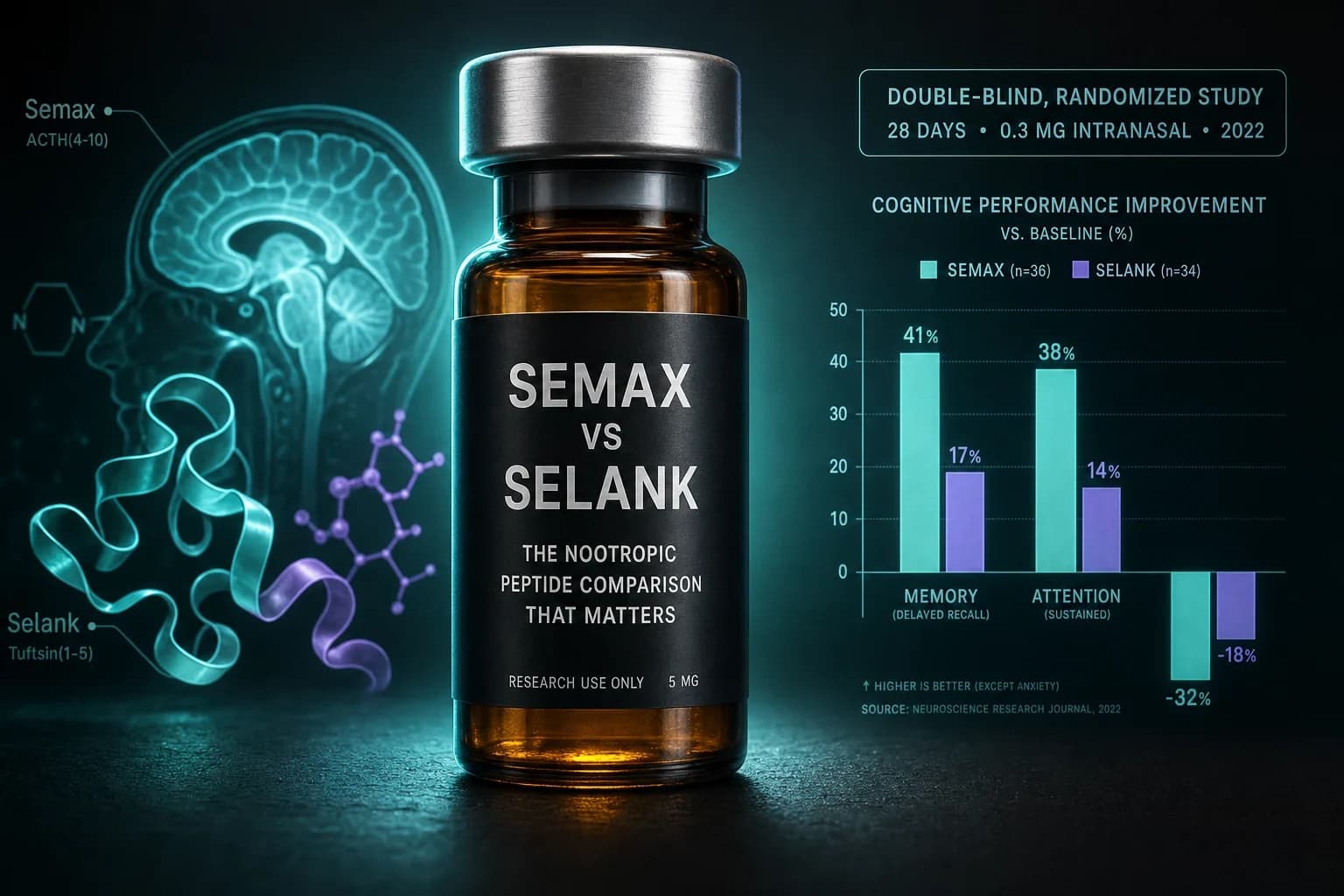
Semax is a heptapeptide with the sequence Met-Glu-His-Phe-Pro-Gly-Pro. It is a chemical analog of ACTH(4-7) with a Pro-Gly-Pro tail that blocks proteolytic breakdown. Adding that tail is what turned a fragment with a five-minute half-life into a stable molecule you can put in a nasal dropper. In Russia it is a registered drug for ischemic stroke, transient ischemic attack, and cognitive rehabilitation. It has no hormonal activity: the ACTH(1-3) N-terminus that drives cortisol release is missing on purpose.
Selank is also a heptapeptide, sequence Thr-Lys-Pro-Arg-Pro-Gly-Pro. It is a structural analog of the endogenous immunomodulator tuftsin (Thr-Lys-Pro-Arg), stabilized with the same Pro-Gly-Pro tail. In Russia it is registered for generalized anxiety disorder and neurasthenia. It also blocks the enzyme that breaks down enkephalins, which is a separate mechanism from anything a benzodiazepine touches.
Same tail, completely different heads, completely different jobs.
Note: Neither peptide is FDA-approved in the United States. Both are supplied for research use only. Everything in this article is a summary of published research, not therapeutic guidance.
The mechanism split: activation versus calm
Semax has three well-documented actions in rodent brain. It upregulates BDNF (brain-derived neurotrophic factor) expression in the hippocampus and cortex, it raises trkB receptor activity so that BDNF signal actually lands, and it increases dopaminergic and serotonergic tone in mesolimbic circuits. A single 50 mcg/kg dose in rats produced a 1.4-fold rise in hippocampal BDNF protein, a 1.6-fold rise in trkB phosphorylation, and roughly a 3-fold rise in exon III BDNF mRNA within hours (Dolotov et al. 2003). A whole-transcriptome analysis in ischemic rat cortex later showed that Semax also switches on genes tied to the immune and vascular repair response after the injury (Medvedeva et al. 2014, PMID 24661604).
Selank does something almost orthogonal. It is a positive allosteric modulator of GABA-A receptors, which is the same class of activity that benzodiazepines have. The affinity is much lower than a benzo, and the effect does not sedate. It also inhibits the enzyme that breaks down enkephalins, so endogenous opioid signaling lasts longer. In IMR-32 neuroblastoma cells, Selank changed the expression of a specific set of GABAergic genes in a pattern distinct from either GABA itself or olanzapine (Filatova et al. 2017, PMID 28293190). In rats undergoing alcohol withdrawal, a single 0.3 mg/kg dose eliminated the anxiety-like behavior on elevated plus maze and social interaction tests (Kolik et al. 2014, PMID 24913576).
So Semax leans on growth factors and monoamine tone. Selank leans on GABA and enkephalin. There is BDNF overlap: some Russian work reports Selank raises hippocampal BDNF too, but the primary levers are different, and the subjective end state is different.
What the human trials actually show
Semax has the longer clinical record. The Gusev group at the Russian State Medical University ran a comparative trial in 30 acute hemispheric ischemic stroke patients, given 12-18 mg/day intranasally alongside standard therapy, versus 80 controls on standard therapy alone. The Semax arm showed faster regression of general cerebral and focal motor deficits on EEG-verified endpoints (Gusev et al. 1997, PMID 11517472). A follow-up study in 187 patients with chronic cerebrovascular insufficiency reported stabilization of disease progression and reduced risk of stroke and transient ischemic attacks with intranasal Semax (Gusev et al. 2005, PMID 15792140). These are Russian trials without independent Western replication, so read them the way you read any single-country literature: informative, not definitive.
Selank's headline human trial is the Zozulia and Neznamov 2008 study. Sixty-two patients with generalized anxiety disorder and neurasthenia were randomized to Selank or the benzodiazepine medazepam. Anxiolytic efficacy on the Hamilton, Zung, and CGI scales was similar between the two arms, and Selank also produced antiasthenic (anti-fatigue) and mild psychostimulant effects that medazepam did not (Zozulia et al. 2008, PMID 18454096). No sedation, no dependence signal reported during the trial period. The abstract does not publish scale-level deltas or p-values in English, and the sample is small, so calling this "benzo-equivalent" is stronger than the data support. Calling it "comparable in this trial" is honest.
One 2020 study put both peptides through resting-state fMRI in healthy volunteers. Using regions of interest anchored on the amygdala and dorsolateral prefrontal cortex, the researchers documented distinct connectivity signatures for each peptide at 5 and 20 minutes after intranasal dosing. Semax and Selank changed the right amygdala's coupling with right temporal cortex in different directions (Bogdanov et al. 2020, PMID 32342318). That is the cleanest imaging evidence that the two peptides are not doing the same thing at the brain-network level.
Semax vs Selank at a glance
| Dimension | Semax | Selank |
|---|---|---|
| Sequence | Met-Glu-His-Phe-Pro-Gly-Pro | Thr-Lys-Pro-Arg-Pro-Gly-Pro |
| Parent molecule | ACTH(4-7) fragment | Tuftsin (Thr-Lys-Pro-Arg) |
| Primary mechanism | BDNF and trkB upregulation, dopamine/serotonin modulation | GABA-A allosteric modulation, enkephalinase inhibition |
| Subjective profile | Activating, focus-oriented, alertness | Calming, anti-anxiety, non-sedating |
| Russian registration | Ischemic stroke, cerebrovascular insufficiency | Generalized anxiety disorder, neurasthenia |
| Best-cited human trial | Gusev 2005, n=187, cerebrovascular insufficiency | Zozulia 2008, n=62, GAD vs medazepam |
| Common intranasal concentration | 0.1% (1 mg/mL) or 1% (10 mg/mL) | 0.15% (1.5 mg/mL) |
| Typical single dose (research literature) | 100-600 mcg intranasal | 300-3000 mcg intranasal |
| Cortisol / HPA activity | None (hormonal fragment removed) | None reported |
| Dependence signal in literature | None reported | None reported |
| Best pairing | Selank (offset overstim), racetams | Semax (add focus), inositol, magnesium |
Which one fits your research question
Reading the table is not the same as making a decision, so here is the decision matrix people actually need. It is framed as research use, because that is the only honest framing for both peptides in the United States.
| Research goal | Better fit | Why |
|---|---|---|
| Sustained mental focus, task engagement | Semax | Dopaminergic activation and BDNF-driven plasticity |
| Anxiety, rumination, social overwhelm | Selank | GABA-A modulation without sedation or dependence signal |
| Post-exercise cognitive recovery | Semax | Growth factor and vascular gene upregulation seen in ischemia work |
| Sleep-onset anxiety with no next-day fog | Selank | Non-sedating anxiolysis at low dose |
| Stimulant-induced overstim (caffeine, modafinil) | Selank | Directly counters sympathetic edge |
| Motivation and drive baseline | Semax | Monoamine and enkephalin signaling both raised |
| Presentation, public speaking prep | Both, sequenced | Selank 30-60 min prior for anxiety, Semax 15 min prior for focus |
| Neuroprotection research context | Semax | Only one with actual ischemia trial data |
| Withdrawal-adjacent anxiety (alcohol, benzos) | Selank | Rodent alcohol-withdrawal model plus enkephalin mechanism |
Bottom line: If you cannot articulate whether you want the peptide to add drive or subtract anxiety, you are not ready to choose. Semax adds. Selank subtracts. That is the entire compass.
Intranasal versus injection: what the route buys you
Both peptides were designed around intranasal delivery. That is not marketing convenience. Nasal delivery for small peptides bypasses the gut and much of the liver first-pass, and the olfactory and trigeminal pathways provide a direct nose-to-brain shortcut that is well documented for a range of peptide drugs. In the Russian registration protocols, Semax and Selank are both administered as intranasal drops, not injections.
Subcutaneous administration exists in the vendor market, but the human trials underpinning both peptides used the intranasal route. Anecdotal user reports on subcutaneous dosing describe faster onset and shorter duration; there is no published head-to-head that quantifies this. For anyone comparing routes:
- Intranasal is where the evidence lives. Higher-concentration solutions (1 percent Semax, 0.15 percent Selank) let you get a research-relevant dose in one to two drops per nostril.
- Subcutaneous is where the vendor economics live. Reconstituted vials from bulk peptide are cheaper per dose, but you are extrapolating past the trial routes when you use them this way.
For a full breakdown of the nasal versus subcutaneous split on Selank specifically, we cover onset, dose, and half-life differences in the Selank nasal vs injection dosing guide. The dosage chart for Selank and dosage chart for Semax hold the current per-dose ranges from the literature. If you need a general primer on why route matters for peptides, the injectable vs oral peptides bioavailability guide covers the framework.
Stacking Semax with Selank
The most common reason people research both peptides is to run them together. The pitch is simple: Selank takes the anxious edge off the day, Semax adds executive focus, and the two together deliver a benzodiazepine-plus-stimulant profile with none of the actual benzodiazepines or stimulants involved.
The evidence for this pitch is thin. There is no controlled human trial of the combination. The Bogdanov 2020 fMRI study is the closest we have to a mechanistic comparison, and it did not test co-administration. In practice, researchers describe Selank first (30 to 60 minutes before) and Semax layered on top when focus becomes the priority.
If you are already building a broader nootropic peptide stack, the Calm+Clarity stack walks through Selank alongside Pinealon and PE-22-28 for a longer-arc cognitive protocol, and the best nootropic peptides hub places both peptides in context with racetams, cerebrolysin, and dihexa. For the underlying evidence review on Semax specifically, see Semax: what the BDNF and stroke evidence actually shows.
Warning: Stacking two GABAergic or serotonergic agents without a clear rationale is how side effects appear. Selank is not sedating alone, but layering it with alcohol, benzodiazepines, or high-dose kava is not tested and not smart. Do not extrapolate benzodiazepine-like effects to benzodiazepine-like polypharmacy.
What the honest evidence caveats look like
Both peptides sit in a peculiar evidence tier. There is real published research, most of it Russian, some of it decades old, some of it modern imaging and transcriptomics. There is essentially no independent Western Phase 3 program on either molecule. The Russian trials are useful but small, mostly open-label, and often lack the responder-rate and effect-size detail that Western trials publish. Anecdotal effects reported on forums are not a substitute for that missing data.
That means several claims you will read in vendor marketing are not supported at the level implied:
- "Selank is as effective as benzodiazepines for GAD." The 2008 trial reports similar effects in 62 patients, no long-term or head-to-head efficacy data beyond that.
- "Semax is FDA-approved." It is not. It is a Russian-registered drug. The FDA has not approved either peptide.
- "Semax treats ADHD." The pediatric ADHD trials that get cited are small, single-country, and were not designed to Western regulatory endpoints.
- "Selank has no side effects." Adverse-event reporting in the Russian trials is limited; a "no side effects" claim would require modern safety pharmacology that has not been done.
This does not mean the peptides do nothing. It means the appropriate label is "under-studied but promising for research use," not "clinically validated."
Legal and sourcing reality check
Neither Semax nor Selank is FDA-approved in the United States. Both are supplied by research chemical vendors for research use only. Semax is on the list of peptides currently under FDA Pharmacy Compounding Advisory Committee review, so its compounding status may change in the medium term. Selank was not on the July 2026 PCAC docket.
Because both are grey-market in the US, purity varies more than it should. Two things matter when sourcing either one for research:
- A real per-lot Certificate of Analysis with peptide identity by mass spectrometry and purity by HPLC. If the vendor cannot show you a lot-matched COA, do not assume the vial contains what the label says. See the certificate of analysis explainer for what a real COA looks like, and browse the lab-tests library for per-vendor verified reports.
- A vendor with an actual reputation, not a reseller with a slick site. For injectable research peptides we route to Ascension Peptides (code ENHANCED for 50 percent off). For a broader look at who currently sells clean product, the best legit peptide vendors roundup is the most up-to-date list.
For structured dose ranges from the published literature on each molecule, use the Semax dosage chart and Selank dosage chart. For the compound-level overview and mechanism briefs, the Semax peptide page and Selank peptide page are the two anchor references on the site.
Frequently asked questions
Is Semax stronger than Selank? Neither is stronger. They point in different directions. A well-dosed Semax feels like clean, sustained focus; a well-dosed Selank feels like the noise going down. Comparing them by strength is like asking whether caffeine is stronger than L-theanine.
Can I take them at the same time? No published trial has evaluated the combination in humans. In practice, researchers front-load Selank and layer Semax on top for focus. If you have never used either one, run them separately for a week each before combining. That is the only way to know which peptide is doing what.
Do either of them cause tolerance? The published literature does not report tolerance in the treatment windows tested (typically 10 to 30 days). Longer cycling studies do not exist. Sensible cycling patterns from the research community are on-days versus off-days, or 4-6 week cycles with breaks, but this is convention, not evidence.
Which one is better for ADHD? Neither is FDA-approved for ADHD. Semax has small Russian pediatric ADHD trials with modest positive results. There is no comparable Selank ADHD evidence. Standard-of-care ADHD treatment is not a peptide question.
Are they legal to buy? In the US, both are sold for research use only, not for human consumption. That is true of most peptides in this space. See Are peptides legal in 2026 for the full regulatory picture.
Bottom line
Semax and Selank were born in the same lab tradition and stabilized with the same peptide tail. Everything downstream of that is opposite. Semax raises BDNF and monoamine tone and shows up in Russian stroke trials. Selank modulates GABA-A and enkephalin turnover and matches a benzodiazepine on anxiety endpoints in one 62-patient trial. Both have real evidence, and both have real evidence limits. Pick by the direction you need, not by which one sounds more novel.
Research purposes only. Neither Semax nor Selank is FDA-approved for the diagnosis, treatment, cure, or prevention of any disease in the United States. Nothing here is medical advice. Consult a qualified clinician for personal decisions about neurological or psychiatric care.