At a glance
- IGF-1 LR3 (Long R3 IGF-1) has an arginine substitution at position 3 plus a 13-amino-acid N-terminal extension that reduces IGFBP binding
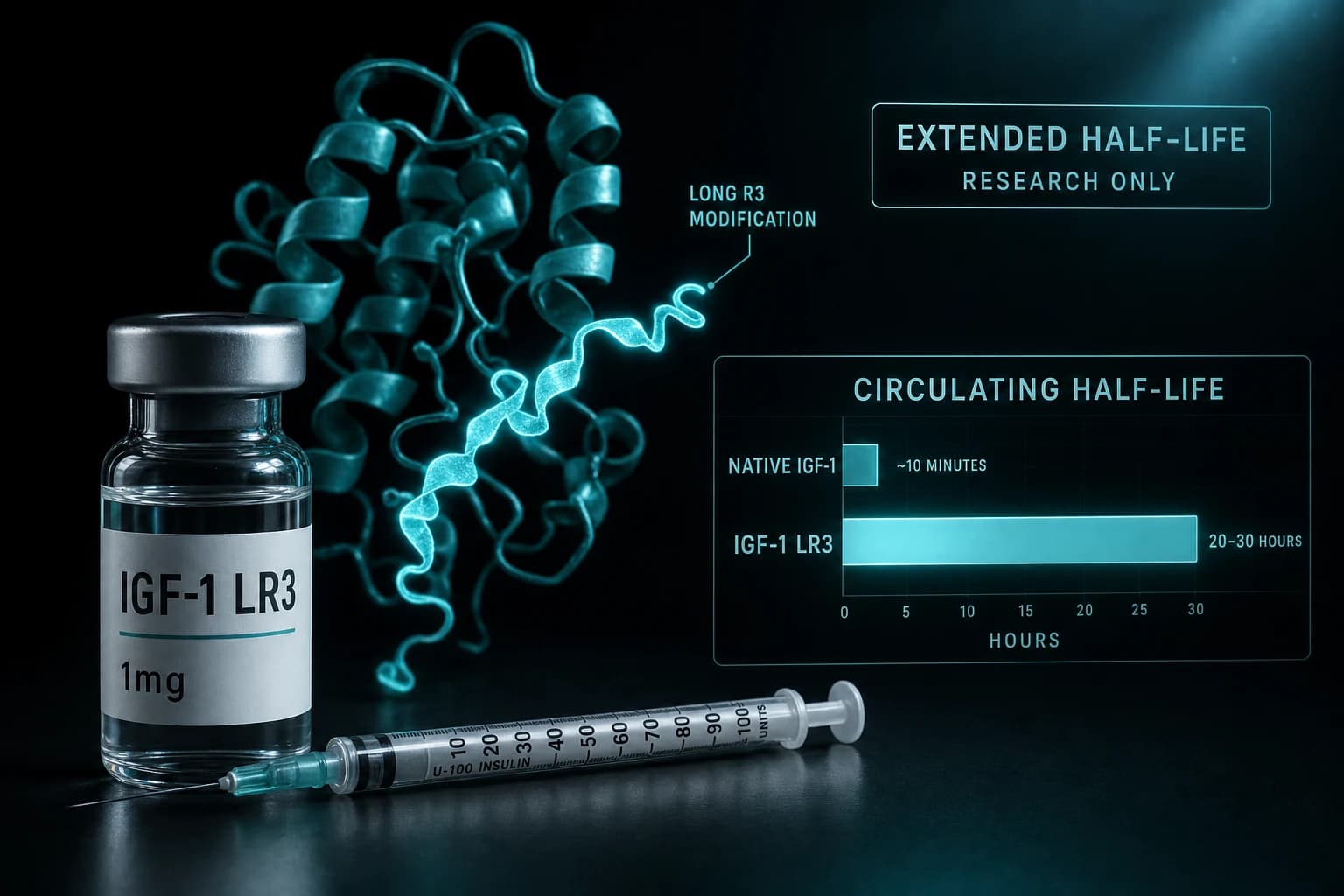
- Reduced IGFBP binding produces a 20-30 hour circulating half-life versus minutes for native IGF-1, supporting once-daily dosing
- Standard research dose: 20-50 mcg once daily subcutaneous, often pre-workout or pre-bed; cycles capped at 4-6 weeks to limit cumulative IGF-1 exposure
- Hypoglycemia is the dose-limiting acute risk; IGF-1 LR3 produces insulin-like effects and patients should monitor glucose particularly in first 1-2 hours post-injection
- Long-term IGF-1 elevation theoretically increases tumor growth risk; not appropriate for patients with active malignancy or strong cancer family history
IGF-1 LR3 is the modified version of insulin-like growth factor 1 that solved the half-life problem. Native IGF-1 is bound to IGFBPs (IGF binding proteins) within minutes of release and cleared rapidly; the practical implication is that injecting native IGF-1 produces a transient peak that doesn't sustain meaningful tissue exposure. IGF-1 LR3 has structural modifications that reduce IGFBP binding, producing a 20-30 hour circulating half-life that supports once-daily dosing and sustained tissue effects.
This article covers what IGF-1 LR3 actually is, why the half-life advantage matters, the standard research dose protocols, the hypoglycemia and tumor-growth risks that constrain its use, and how it fits with other research peptides in muscle and recovery applications.
What IGF-1 LR3 actually is
Native human IGF-1 is a 70-amino-acid peptide with strong structural similarity to proinsulin. It binds the IGF-1 receptor on muscle cells, satellite cells, and many other tissues to drive growth, protein synthesis, and metabolic effects.
IGF-1 LR3 has two structural modifications from native IGF-1:
-
Arginine substitution at position 3 (R3). The glutamic acid at position 3 of native IGF-1 is replaced with arginine. This reduces IGFBP binding affinity substantially.
-
N-terminal 13-amino-acid extension (LR). A 13-residue extension at the N-terminus further reduces IGFBP binding.
Together, these modifications produce:
| Property | Native IGF-1 | IGF-1 LR3 |
|---|---|---|
| Length | 70 amino acids | 83 amino acids |
| IGFBP binding | Strong (~99% bound in circulation) | Reduced (~80% bound) |
| Circulating half-life | Minutes | 20-30 hours |
| IGF-1 receptor binding | Normal | Similar or slightly reduced |
| Insulin receptor binding | Negligible | Detectable cross-reactivity at high doses |
The half-life extension is the practical advantage. Native IGF-1 injection produces a brief peak followed by rapid clearance via IGFBP-mediated mechanisms. IGF-1 LR3 maintains meaningful circulating concentration for a full day, supporting sustained tissue exposure with once-daily dosing.
The original biochemical characterization came from Francis et al., J Mol Endocrinol, 1992, which described the IGF-1 LR3 modifications and the binding properties.
Why the half-life matters
The mechanism rationale for sustained IGF-1 exposure:
Tissue receptor saturation. IGF-1 receptor activation requires sustained ligand presence. Brief peak exposures with rapid clearance produce minimal sustained signaling. IGF-1 LR3's 20-30 hour half-life maintains receptor activation across the full dosing interval.
Protein synthesis windows. Skeletal muscle protein synthesis occurs in waves throughout the day. Sustained IGF-1 exposure across these waves produces measurable hypertrophy effects in animal models. Transient peaks do not.
Satellite cell activation. Muscle stem cells (satellite cells) require sustained IGF-1 signaling for proliferation and differentiation. The pharmacokinetic profile of IGF-1 LR3 supports this requirement; the profile of native IGF-1 does not.
For animal studies establishing the systemic muscle effects, Tomas et al., J Endocrinol, 1993 characterized IGF-1 LR3 in rodent muscle models and confirmed measurable hypertrophy with sustained exposure that native IGF-1 did not reproduce.
The standard research protocol
Across published preclinical work and forum-documented research protocols, the convergent dosing:
| Phase | Dose | Frequency | Timing | Duration |
|---|---|---|---|---|
| Conservative | 20 mcg | Once daily | Morning or pre-bed | 4-6 weeks |
| Standard | 30-50 mcg | Once daily | Pre-workout or pre-bed | 4-6 weeks |
| Localized injection | 20-40 mcg | Once daily | SC near target muscle | 4-6 weeks |
Three reasons most research protocols stay in the 20-50 mcg range:
-
Receptor saturation. Higher doses do not produce proportionally larger IGF-1 receptor effects. The dose-response flattens beyond approximately 50 mcg.
-
Hypoglycemia risk scales with dose. IGF-1 LR3 has detectable insulin-like activity at high doses. Hypoglycemia risk increases meaningfully above 50 mcg per injection.
-
Cycle duration matters. Long cycles with high doses produce sustained IGF-1 elevation that may carry tumor-growth risk concerns. Standard 4-6 week cycles with conservative doses limit cumulative exposure.
For reconstitution math, most retail IGF-1 LR3 ships as 1 mg vials. Reconstituting with 1 mL bacteriostatic water produces 1 mg/mL. A 0.04 mL draw (4 IU on a U-100 insulin syringe) delivers 40 mcg.
Hypoglycemia: the dose-limiting acute risk
IGF-1 LR3 has measurable insulin-like activity at the high end of research-protocol doses. The mechanism: IGF-1 LR3 can cross-react with the insulin receptor, particularly at supraphysiological tissue concentrations. The result is acute hypoglycemia that resembles insulin-induced hypoglycemia.
Reported pattern:
| Time post-injection | Glucose effect |
|---|---|
| First 30 minutes | Transient mild glucose drop |
| 30 minutes to 2 hours | Peak hypoglycemia risk |
| 2-6 hours | Glucose stabilization |
| Beyond 6 hours | Effect typically minimal |
Practical mitigations researchers commonly use:
- Pre-injection meal. Eating before injection blunts the acute glucose drop.
- Carbohydrate availability. Have rapid-acting carbohydrates available for symptomatic hypoglycemia.
- Dose conservatism. Lower doses (20-30 mcg) carry less hypoglycemia risk than higher doses (50+ mcg).
- Pre-bed injection. Some researchers prefer pre-bed dosing so the hypoglycemia window passes during sleep, though this carries its own risk if hypoglycemia becomes severe.
Patients with diabetes, particularly insulin-using diabetes, should not use IGF-1 LR3. The interaction with insulin therapy can produce dangerous hypoglycemia.
Bottom line: Hypoglycemia is the most reliable acute side effect of IGF-1 LR3 injection. Conservative dose (20-30 mcg), pre-injection food, and glucose monitoring are the standard mitigation pattern.
Long-term cancer concern
IGF-1 signaling is mechanistically associated with cell proliferation, including in tumor biology contexts. Sustained elevation of circulating IGF-1 has been associated with increased risk for several cancer types in observational studies, particularly prostate, colorectal, and breast cancer.
IGF-1 LR3 research-grade use is not appropriate for:
- Patients with active malignancy. The mechanism case for accelerating tumor growth is direct.
- Patients with strong family history of cancer. Particularly for cancers where IGF-1 signaling is implicated.
- Long-term continuous use. Cumulative IGF-1 elevation over months or years has different risk profile than short defined cycles.
The risk magnitude for short defined cycles in cancer-free research subjects is not well-characterized but is presumed to be lower than for sustained elevation. The conservative position: short cycles, defined washouts, and screening for cancer risk factors before research-use protocols.
IGF-1 LR3 versus GH-secretagogue approaches
IGF-1 LR3 acts directly on the IGF-1 receptor. GH secretagogues (CJC-1295, Ipamorelin, Sermorelin) act upstream to drive endogenous GH production, which in turn drives endogenous IGF-1 production through hepatic IGF-1 synthesis.
| Approach | Mechanism | Pros | Cons |
|---|---|---|---|
| IGF-1 LR3 direct injection | Direct IGF-1R activation | Direct, controllable dose, fast effect | Hypoglycemia risk, cancer concern, single pathway |
| GH secretagogue + native IGF-1 production | Endogenous GH → liver IGF-1 | Physiological pulse pattern, lower direct risk | Slower effect, age-dependent response |
| MK-677 (oral GH secretagogue) | Oral GH stimulation | Convenient, established long-term data | Modest effect, daily dosing required |
For most general research applications, the GH secretagogue approach (the FIT Stack CJC-1295 + Ipamorelin protocol) is the cleaner default. Direct IGF-1 LR3 injection is the right choice for specific research where the IGF-1 receptor pathway needs to be activated directly and rapidly, and where the hypoglycemia and cancer-concern trade-offs are acceptable.
For broader context, see the Sermorelin vs CJC-1295 vs Ipamorelin comparison and the MK-677 (Ibutamoren) oral GH secretagogue guide.
Stacking IGF-1 LR3 with other compounds
Common stack patterns:
- IGF-1 LR3 + CJC-1295 + Ipamorelin: Direct IGF-1 receptor activation plus endogenous GH pulses. Mechanistically additive but increases injection count and complexity.
- IGF-1 LR3 + testosterone base: Common in athletic research contexts. Testosterone drives muscle protein synthesis through different mechanism; combination addresses multiple pathways.
- IGF-1 LR3 + recovery peptides (BPC-157, TB-500): Muscle hypertrophy support plus connective tissue repair. The Wolverine Stack covers the BPC-157 + TB-500 base.
None of these stack combinations have direct published trial data; mechanism extrapolation is the rationale.
How IGF-1 LR3 fits the 2026 regulatory landscape
IGF-1 LR3 was not among the 14 peptides reclassified to Category 1 in the Feb 27, 2026 HHS announcement. It remains a research compound without compounding-pharmacy access through standard 503A pathways. Research-grade retail availability through peptide vendors continues to be the practical channel.
WADA classifies IGF-1 and its analogs (including IGF-1 LR3) as prohibited substances under category S2 (Peptide Hormones, Growth Factors, Related Substances and Mimetics). Athletes in WADA-compliant testing pools should not use IGF-1 LR3.
For the broader regulatory context, see the FDA peptide reclassification February 2026 complete breakdown.
Sourcing
For research-grade injectable IGF-1 LR3, Ascension Peptides carries it in the GH/IGF-1 catalog with public per-batch COAs and 50% off using code ENHANCED. For our broader sourcing analysis, see the best legit peptide vendors 2026 ranking.
FAQ
What is IGF-1 LR3?
IGF-1 LR3 (Long R3 IGF-1) is a modified version of insulin-like growth factor 1 with an arginine substitution at position 3 and a 13-amino-acid N-terminal extension. These modifications reduce binding to IGF binding proteins, producing a 20-30 hour circulating half-life versus minutes for native IGF-1.
Why does IGF-1 LR3 have a longer half-life than native IGF-1?
Native IGF-1 is rapidly bound by IGF binding proteins (IGFBPs) in circulation, which produces fast clearance. IGF-1 LR3 has structural modifications that reduce IGFBP binding affinity, leaving more free peptide in circulation for longer. The trade-off is slightly different receptor affinity profile, but the half-life extension is substantial.
What is the standard IGF-1 LR3 research dose?
20-50 mcg once daily subcutaneous for 4-6 week cycles. The lower end (20-30 mcg) is the conservative research dose; the upper end (50 mcg) approaches the dose where hypoglycemia risk increases meaningfully. Higher doses do not produce proportionally larger muscle effects due to receptor saturation.
Is hypoglycemia a real concern with IGF-1 LR3?
Yes. IGF-1 LR3 has detectable insulin receptor cross-reactivity at the high end of research-protocol doses. Acute hypoglycemia 30 minutes to 2 hours post-injection is the most common acute side effect. Pre-injection meal, conservative dose, and glucose monitoring are the standard mitigation. Diabetic patients should not use IGF-1 LR3.
Does IGF-1 LR3 cause cancer?
Sustained IGF-1 elevation has been associated with increased risk for several cancer types in observational studies (prostate, colorectal, breast). The risk magnitude for short defined research-protocol cycles in cancer-free subjects is not well-characterized but is presumed lower than for sustained chronic elevation. Patients with active malignancy or strong cancer family history should not use IGF-1 LR3.
Should I use IGF-1 LR3 or GH secretagogues?
For most research applications, the GH secretagogue approach (CJC-1295 + Ipamorelin) is the cleaner default because it works through endogenous GH pulses and avoids direct IGF-1 receptor manipulation. Direct IGF-1 LR3 injection is the right choice when the research question specifically requires rapid, direct IGF-1 receptor activation and the hypoglycemia/cancer trade-offs are acceptable.
How long should an IGF-1 LR3 cycle be?
4-6 weeks is the standard cap. Longer cycles produce sustained IGF-1 elevation that increases cumulative cancer-concern exposure without producing proportionally larger muscle effects. Extended washouts (4-8 weeks off-cycle) between cycles are the typical research pattern.
Further reading
- Sermorelin vs CJC-1295 vs Ipamorelin comparison
- FIT Stack CJC-1295 + Ipamorelin GH protocol
- Hexarelin GHRP dosing and cortisol risk guide
- MK-677 (Ibutamoren) oral GH secretagogue guide
- ACE-031 (ramatercept) myostatin inhibitor research review
- Follistatin 344 myostatin pathway research
- Wolverine Stack: BPC-157 + TB-500 recovery protocol
- Best legit peptide vendors 2026
- Reconstitution Calculator
This article is for educational and research purposes only. IGF-1 LR3 is sold under research-use disclosures and is not approved by the FDA for any indication. WADA-tested athletes should not use IGF-1 LR3. Patients with diabetes, active malignancy, or strong cancer family history should not use IGF-1 LR3. None of the content above constitutes medical advice.