At a glance
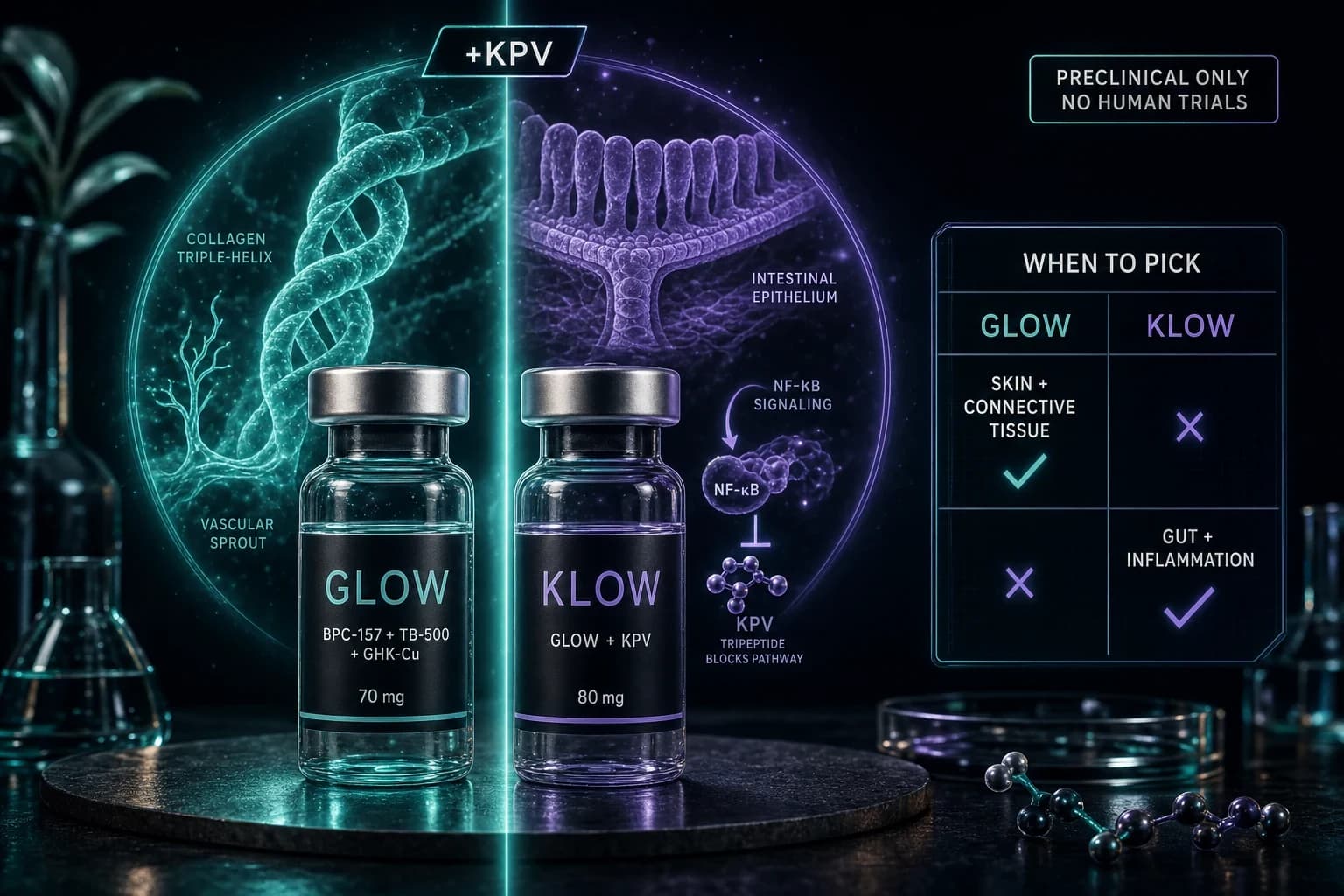
- GLOW = BPC-157 + TB-500 + GHK-Cu. KLOW = the same three plus KPV.
- GHK-Cu is dosed at ~50 mg per vial in both blends, doing most of the collagen-synthesis work (Maquart et al. 1988, PMID 3169264).
- KPV is the KLOW-only NF-kB inhibitor, strongest in gut and dermal inflammation models (Land et al. 2003, PMID 12750433).
- Neither blend has a peer-reviewed human trial; all evidence is preclinical or on individual peptides.
- Pick GLOW for skin and connective-tissue research. Pick KLOW when NF-kB inhibition (gut, barrier) is central to the design.
The short version: GLOW and KLOW are the same three-peptide skin and recovery stack, plus one more molecule in KLOW that changes what the blend is actually good for. GLOW is BPC-157, TB-500, and GHK-Cu. KLOW adds KPV, an anti-inflammatory tripeptide clipped from alpha-MSH. If you are researching skin remodeling and general connective-tissue recovery, GLOW is enough. If gut inflammation, IBD models, or barrier repair sits inside the research question, KPV is what makes KLOW distinct. Everything else in the two labels is identical.
Bottom line: GLOW is the collagen and vascular repair stack. KLOW is GLOW plus an NF-kB inhibitor for inflammation-driven questions, particularly around the gut and dermal barrier. The molecules are the same class of research peptides sold by Ascension Peptides with code ENHANCED at 50% off. The upgrade to KLOW only pays for itself when the study design actually needs KPV.
What is in each blend
Vendors ship these under a lot of different logos, but the compositional pattern is remarkably consistent across the market. GLOW carries three peptides. KLOW carries the same three at the same ratios, plus KPV.
| Component | GLOW blend | KLOW blend | Class | Mechanism |
|---|---|---|---|---|
| BPC-157 | 10 mg | 10 mg | Pentadecapeptide, gastric protection compound fragment | Angiogenesis, cell migration, cytoprotection |
| TB-500 | 10 mg | 10 mg | Thymosin beta-4 fragment (Ac-SDKP surrogate) | Actin sequestration, endothelial migration |
| GHK-Cu | 50 mg | 50 mg | Copper-binding tripeptide | Collagen synthesis, MMP modulation, gene regulation |
| KPV | not present | 10 mg | Alpha-MSH C-terminal tripeptide | NF-kB inhibition, IL-1beta blockade |
Two things worth flagging. First, the GHK-Cu load in these blends (roughly 50 mg per vial) is much larger than in single-peptide GHK-Cu products, which usually ship at 10 to 50 mg total. The reconstitution math actually matters here, and it is different from what a stand-alone GHK-Cu protocol would look like. Our reconstitution calculator handles the split. Second, KPV in the KLOW format is a subcutaneous injection alongside three other injectables. Most of the KPV literature is oral or nanoparticle-delivered, and none of it is on this specific four-peptide combination. That mismatch matters when you read the evidence, which comes next.
What each peptide actually does, and what the studies actually show
Every claim below is anchored to a specific paper. The competitive articles that currently rank for "glow vs klow" cite almost none of them, which is one of the reasons the SERP is thin.
BPC-157
BPC-157 is a 15-amino-acid fragment of a larger gastric protection compound found in human gastric juice. Its research base is heavily preclinical and heavily Croatian. The mechanism most commonly described is upregulation of vascular endothelial growth factor and improved cell migration.
- In a rat Achilles tendon detachment model, BPC-157 promoted tendon-to-bone healing and opposed corticosteroid-driven aggravation (Krivic et al. 2006, PMID 16583442).
- BPC-157 accelerated tendon fibroblast outgrowth, improved cell survival under H2O2 stress, and increased migration in a dose-dependent way (Chang et al. 2011, PMID 21030672).
- In an ileoileal anastomosis rat model, BPC-157 (labelled PL14736 in the pharma pipeline) improved healing after gut surgery (Sikiric et al. 2007, PMID 17713731).
There is no completed peer-reviewed human trial reporting BPC-157 outcomes for musculoskeletal or gut endpoints. A Phase II program under the name PL14736 was run for ulcerative colitis and ended without a published pivotal result. Anyone selling BPC-157 as a proven human therapy is overreaching. For a deeper mechanism read, see BPC-157 vs TB-500 recovery peptides.
TB-500
TB-500 is a synthetic fragment marketed as thymosin beta-4, though the two are not perfectly interchangeable (full-length TB4 is 43 residues, TB-500 is a shorter active fragment). The pivotal preclinical work is the Philp, Goldstein, and Kleinman line on angiogenesis, wound healing, and hair follicle activity.
- In a rat full-thickness wound model, thymosin beta-4 raised re-epithelialization by 42 percent at day 4 and 61 percent at day 7 versus saline controls, with more collagen and denser angiogenesis in treated wounds (Philp et al. 2003, PMID 15037013).
- Mechanistically, TB4 promotes endothelial progenitor cell angiogenesis through a VEGF-dependent pathway and works upstream of actin sequestration.
Again, human data are sparse. There are small early-phase trials in venous ulcers and dry eye, and a discontinued RegeneRx cardiac program. Nothing is approved. See TB-500 for a fuller mechanism map.
GHK-Cu
The strongest evidence in either blend actually sits with GHK-Cu. Loren Pickart isolated GHK from human plasma in 1973, and the copper complex has been studied for more than 50 years across dermatology, wound healing, and gene expression.
- In cultured human fibroblasts, GHK-Cu stimulated collagen synthesis at concentrations as low as 10^-12 M, peaking at 10^-9 M, without changing cell number, meaning the effect was on collagen production per cell (Maquart et al. 1988, PMID 3169264).
- A 2018 review documented that GHK-Cu modulates roughly 4,000 human genes and drives tissue repair across skin, lung, bone, liver, and stomach lining (Pickart and Margolina 2018, PMID 29986520).
- Topical GHK-Cu has real regulatory precedent in cosmetics, though injectable clinical trial data remain sparse.
If a research protocol is centered on skin remodeling, wound closure, or MMP balance, GHK-Cu is doing most of the heavy lifting in both blends. Our GHK-Cu compound page and the broader copper peptides guide go into the mechanism in more depth.
KPV (the KLOW-only addition)
KPV is the C-terminal tripeptide of alpha-MSH: lysine, proline, valine. It keeps the parent hormone's anti-inflammatory activity but drops the pigmentation effect. The mechanism is best characterized as NF-kB blockade with IL-1beta downstream suppression, and evidence points to receptor-independent action.
- KPV significantly reduced polymorphonuclear leukocyte accumulation in a mouse peritonitis model, with the effect not blocked by the melanocortin 3/4 receptor antagonist SHU9119, meaning the anti-inflammatory activity is not routed through classic MC receptors (Land et al. 2003, PMID 12750433).
- Alpha-MSH derived peptides, KPV among them, act across dermatitis, cutaneous vasculitis, inflammatory bowel disease models, arthritis, and ocular inflammation (Brzoska et al. 2008, PMID 17934097).
- KPV showed anti-inflammatory activity in murine colitis models when transported into cells via the PepT1 oligopeptide transporter, which is why some of the newer work uses PepT1-targeted nanodrug delivery (Bao et al. 2024, PMID 39211778).
Read carefully: nearly all of the KPV mechanism data uses oral delivery or nanoparticle carriers, precisely because PepT1 sits on gut epithelium and gives the peptide a clean entry route. Subcutaneous KPV, which is how it arrives inside KLOW, has less direct evidence, though systemic anti-inflammatory activity has been demonstrated in the peritonitis work above. Our long-form KPV oral peptide gut inflammation research piece covers the route-of-administration tradeoff in more depth.
Evidence quality: what a careful reader should notice
Both blends carry a real research base for each individual peptide. Neither has a peer-reviewed human trial reporting outcomes for the blend as delivered. That is not a criticism unique to GLOW or KLOW; it is the norm for multi-peptide research stacks. Being honest about it is what separates a research protocol from a marketed therapy.
| Component | Strongest evidence tier | Human data on the exact use case? |
|---|---|---|
| GHK-Cu | Multiple animal wound-healing studies, in vitro collagen synthesis, cosmetic topical use | Topical dermatological data exists; injectable clinical data limited |
| BPC-157 | Extensive rodent gut and tendon repair models | Phase II colitis program (PL14736) never yielded a pivotal publication |
| TB-500 | Rodent wound-healing and cardiac repair | Small early-phase venous ulcer and dry eye trials, no approval |
| KPV | Colitis, dermatitis, and peritonitis animal models; PepT1-transport pharmacology | No large human trial; most delivery is oral or nanoparticle, not subcutaneous |
If a question you are researching demands human clinical certainty, neither blend meets that bar. What they offer is a mechanistically coherent, well-characterized combination of individual peptides where the preclinical logic supports pairing angiogenesis, collagen synthesis, and cell migration, with KLOW layering in an inflammation-pathway modulator on top.
When each blend actually makes sense
The competitor swap test on this comparison is brutal. "GLOW is for skin and KLOW is for gut" is a template you can find on 20 different vendor blogs, and it is too vague to help a researcher decide. Here is the sharper framework.
Pick GLOW when the research is centered on:
- Skin remodeling, collagen density, and MMP-driven aging endpoints. GHK-Cu is the dominant molecule and it is already dosed high (50 mg) in the blend.
- Musculoskeletal soft-tissue recovery, particularly tendon and ligament outgrowth models where BPC-157 and TB-500 do the migration and angiogenesis work.
- Wound closure or scar remodeling where NF-kB inhibition is not the central pathway.
Reach for KLOW when the research is centered on:
- Gut inflammation models: IBD, colitis, or intestinal barrier repair. KPV was originally characterized in exactly these systems.
- Dermal barrier plus inflammation combined, for example atopic dermatitis models where you want both matrix remodeling and cytokine suppression.
- Any protocol that already includes an inflammatory driver and where a mechanistic NF-kB block is part of the design rather than an afterthought.
Skip both when:
- The research does not need multi-pathway coverage. If the pathway of interest is only collagen synthesis, single-peptide GHK-Cu is cleaner and cheaper. If the target is only tendon migration, the Wolverine stack (BPC-157 plus TB-500) already covers that pair without paying for the extras.
- Anyone is promising human clinical outcomes. Both blends sit in the research-only lane.
Dosing and reconstitution
The individual peptide doses in these vials are non-trivial, and the reconstitution math is not the same as a single-peptide protocol. On the common 70mg GLOW vial (GHK-Cu 50mg, BPC-157 10mg, TB-500 10mg), a daily draw sized to 2mg GHK-Cu delivers about 400mcg BPC-157 and 400mcg TB-500. That is not three independent 250-500mcg shots. Every published protocol for the individual peptides was designed around a single molecule at a controlled concentration.
Our full GLOW peptide dosage chart walks through the unit-to-mcg math for that 70mg 50/10/10 vial, and the reconstitution calculator handles the arithmetic when you change bacteriostatic water volume. For deeper dosing framework on the individual components, see BPC-157 and KPV. KPV dosing in particular varies with delivery route: subcutaneous protocols run smaller than the oral protocols that dominate the published literature.
Two practical points that vendor blogs almost never mention:
- All four peptides are typically reconstituted into a single vial for both GLOW and KLOW. That means a single injection delivers all components at once, which is convenient but removes the ability to titrate components independently.
- Storage matters more with a multi-peptide vial than a single-peptide one, because degradation of any one component (especially the sensitive BPC-157 backbone) affects the whole blend. Reconstituted vials should be refrigerated and used within the shelf-life window the vendor specifies.
Vendor and COA reality
The other axis that separates a serious research protocol from a Reddit purchase is vendor trust. Peptide potency and purity vary widely across sellers, and the market is not FDA-regulated for research chemicals. What separates a defensible vendor is public per-batch certificates of analysis, third-party HPLC verification, and a shipping history that stands up to scrutiny. Our COA library is the place to check third-party purity data for individual research peptides before running a protocol that assumes the stated dose is what actually landed in the vial.
For the GLOW and KLOW blends specifically, the vendor we point to for injectable research peptides is Ascension Peptides, which carries the individual components under code ENHANCED at 50 percent off. The more recent Ascension review from 2026 covers what has changed in shipping, COA availability, and current stock. That routing exists for a reason: buying multi-peptide blends from an unknown vendor is exactly where the identity and dose accuracy risks compound.
The short answer
GLOW is the collagen-and-vascular-repair stack for research questions in skin remodeling, wound closure, and soft-tissue recovery. KLOW is that same stack with an NF-kB inhibitor bolted on for gut inflammation, dermal barrier plus cytokine work, or any protocol that specifically needs an anti-inflammatory arm. The molecules are well-characterized individually in preclinical models. None of them, in blend form, has a peer-reviewed human trial supporting a clinical outcome. Pick based on the pathway the study needs, not on which label sounds more complete.
Note: This article is written for research purposes and reflects preclinical and mechanistic evidence. It is not medical advice, is not a suggestion to self-administer any peptide, and is not a substitute for clinical guidance. Peptides discussed here are not approved by the FDA for the uses described.