At a glance
- Across randomized trials, the most consistent findings are mild local injection-site discomfort and transient liver enzyme fluctuations.
- The best safety data come from hepatitis B and sepsis trials run under clinical supervision, not from self-directed use.
- Several trial arms reported no serious drug-related adverse events, but most trials were small and short, so rare events are poorly characterized.
- No trial tested people who inject unregulated research-grade vials, so source quality is an unmeasured safety variable.
- Immunosuppressed patients and people with active autoimmune disease are the groups where a prescriber's input matters most.
What the trials show about thymosin alpha 1 side effects
Thymosin alpha 1 (Ta1, thymalfasin, sold as Zadaxin in some countries) has been studied in humans for decades, which gives it a larger safety record than most peptides sold for research use. That record comes with limits. The trials were run in hospital and clinic settings, in specific diseases, with pharmaceutical-grade product. Almost none of it describes a healthy adult self-injecting a vial from a gray-market source.
This guide separates what the human trials reported from what remains unknown. For mechanism and efficacy, see our thymosin alpha-1 clinical evidence review. For compound basics, the thymosin alpha-1 profile and dosage chart cover format, storage and typical research protocols. None of this is medical advice.
Side effect summary by trial
| Setting | Population | What was reported | Evidence quality |
|---|---|---|---|
| Chronic hepatitis B | 316 patients, randomized | Mild adverse reactions, mostly liver enzyme fluctuations, similar at two doses | Randomized, supervised |
| Severe sepsis (ETASS) | 361 ICU patients, randomized | No serious drug-related adverse events recorded | Randomized, single-blind |
| Chronic hepatitis C pilot | 19 patients, double-blind | Local discomfort at injection sites in some patients; no efficacy seen | Very small |
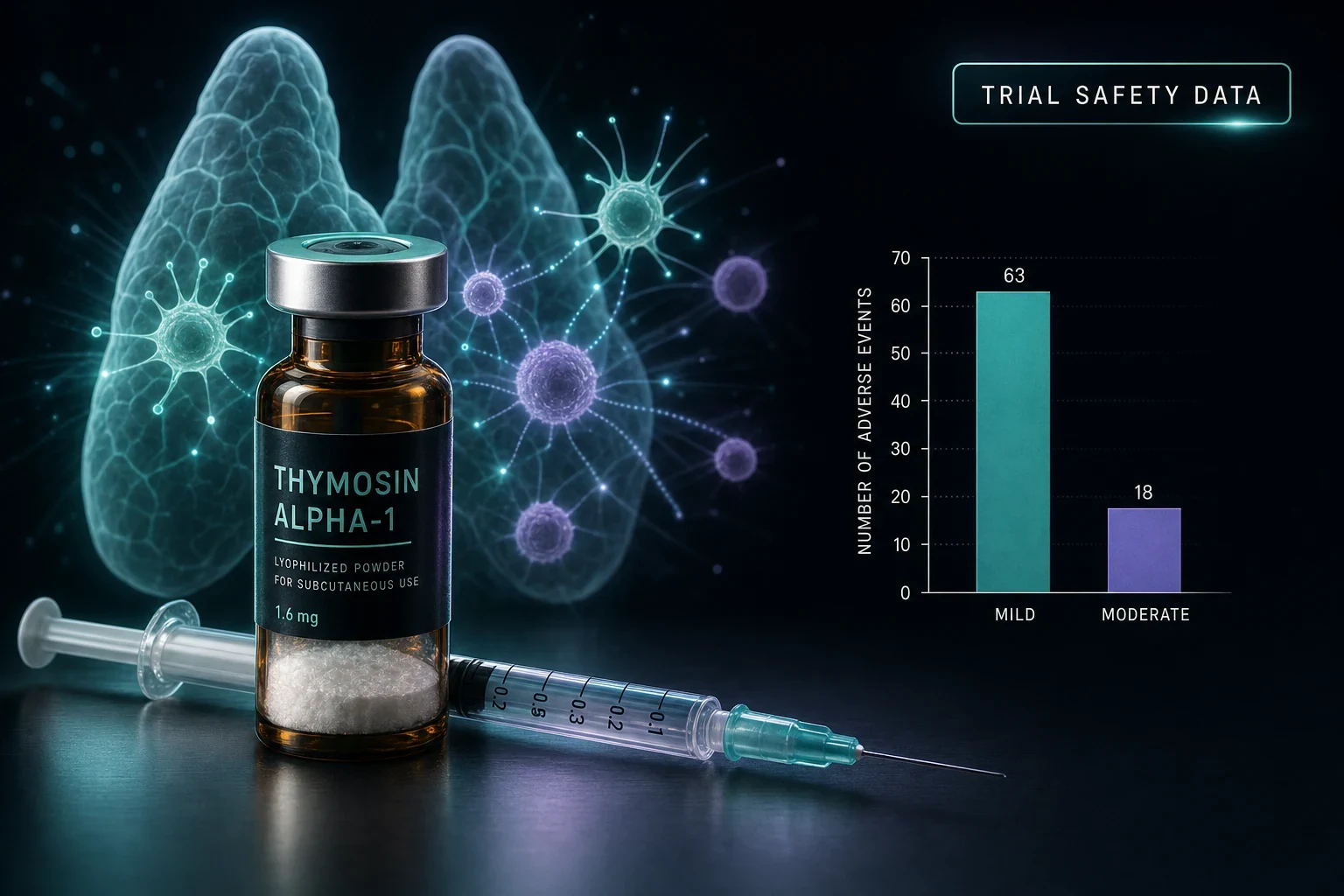
| Moderate-to-severe COVID-19 | 105 dosed patients, phase III | 67 adverse events in 42 patients; 43 mild, 16 moderate, 8 serious (deaths) in a critically ill population | Randomized, placebo-controlled |
| COVID-19 pilot | Hospitalized, hypoxemic, lymphopenic | Serious events occurred but were judged unrelated to Ta1 | Small, open-label |
Everything in that table comes from patients who were already ill. Adverse events in sick populations are hard to attribute, which is why the sepsis and COVID-19 numbers say less about Ta1 than they appear to.
Injection-site reactions
The most consistent finding is local. In a double-blind pilot trial in chronic hepatitis C, no side effects were reported other than discomfort at the injection site in some treated patients. The trial was too small (19 patients) to detect anything uncommon, and it found no efficacy, so treat it as a tolerability note only.
Ta1 is given subcutaneously. Redness, soreness or a small lump at the site are the expected local effects of any subcutaneous injection, and technique matters. Our peptide injection sites guide covers rotation and technique, and the reconstitution guide covers how reconstitution errors can add irritation (wrong diluent volume, contamination).
Liver enzyme fluctuations
A randomized trial in Japanese patients with chronic hepatitis B compared 0.8 mg and 1.6 mg doses. Adverse drug reactions were all mild, and most involved fluctuations in liver enzymes. The authors suggested this was most likely related to the immune response to the peptide rather than direct toxicity. The incidence was similar between the two doses.
Two caveats apply. First, this population had hepatitis B, where ALT movement is expected as the immune system engages the virus. In a healthy liver the same signal may not occur, and no trial measured it. Second, an enzyme change is a lab finding, not a symptom. Someone using Ta1 off-protocol would only see it with bloodwork. That is the practical argument for a baseline and follow-up panel, and our lab testing page lists what is available for this compound.
What the sepsis trials add
In the ETASS trial, 361 patients with severe sepsis were randomized, and no serious drug-related adverse event was recorded. That is reassuring about acute tolerability in critically ill patients receiving a clinically supervised course.
It does not show that Ta1 is harmless at any dose in any person. The efficacy picture is also less settled than the safety one. A systematic review and meta-analysis of randomized sepsis trials pooled 11 trials and found a lower 28-day mortality with Ta1 overall, but the high-quality and multicenter subgroups did not show a benefit, and trial sequential analysis suggested the total sample was still too small for firm conclusions. For a reader weighing risk against benefit, uncertain benefit raises the bar for tolerating any risk.
COVID-19 data: hard to read for safety
The COVID-19 trials are the most often cited and the least useful for judging side effects. A phase III placebo-controlled study in moderate-to-severe COVID-19 reported 67 adverse events among 42 of 105 dosed patients, including 8 serious events that were deaths. In a hospitalized population with a high baseline mortality, those numbers cannot be assigned to Ta1 without the comparator arm, and we are not drawing that conclusion from the abstract alone.
A pilot trial in hospitalized hypoxemic patients with lymphopenia reported serious adverse events that investigators judged unrelated to Ta1. Separately, a retrospective study of 275 COVID-19 patients found that Ta1 did not restore CD4+ or CD8+ T-cell counts, a reminder that the same peptide can look different across designs. Retrospective cohorts like this one are hypothesis-generating at best.
Who should be cautious
The trial literature does not provide a clean contraindication list for research-peptide use, so the following is reasoning from mechanism, not a finding.
- Immunosuppressed patients, including transplant recipients. Ta1 is an immune modulator. Anyone on drugs that deliberately suppress immunity has a plausible interaction risk and should discuss it with the prescriber, not infer safety from the trials above.
- Active autoimmune disease. Ta1 acts on dendritic cells and T-cell signaling. Whether that could aggravate an autoimmune condition has not been established in controlled trials, so the honest answer is unknown, not safe.
- Pregnancy and breastfeeding. Human data are lacking. We would not use it.
- Anyone on a stack. Ta1 is frequently combined with other peptides. Adverse events in a stack cannot be attributed to a single compound. If you track tolerability, change one variable at a time.
What the trials cannot tell you
Three gaps matter more than any single side effect.
- Duration. The hepatitis B protocols ran for months and the sepsis courses for days. Years of continuous use have no randomized safety data.
- Source quality. Trial product was pharmaceutical grade. Research-grade vials vary in purity, fill accuracy and sterility, and contaminants or wrong dosing can produce effects the trials never saw. A certificate of analysis from a third-party lab is the minimum check, and the gray-market sourcing guide explains why many labels cannot be trusted.
- Healthy-user effects. Almost every trial population was sick. How a healthy adult responds is largely extrapolation.
Practical notes for researchers
- Reconstitute with bacteriostatic water and follow storage limits; see how long peptides last in the fridge.
- Keep a log of dose, date, site and any symptom. Local reactions that spread, heat, or persist beyond a few days are worth medical attention.
- Get baseline liver enzymes before starting and repeat them if you continue.
- Compare vendors on testing transparency, not price. Our vendor audit and the Ascension Peptides review describe what batch documentation to expect. Ascension carries thymosin alpha-1 in a 10 mg vial, and code ENHANCED applies at checkout.
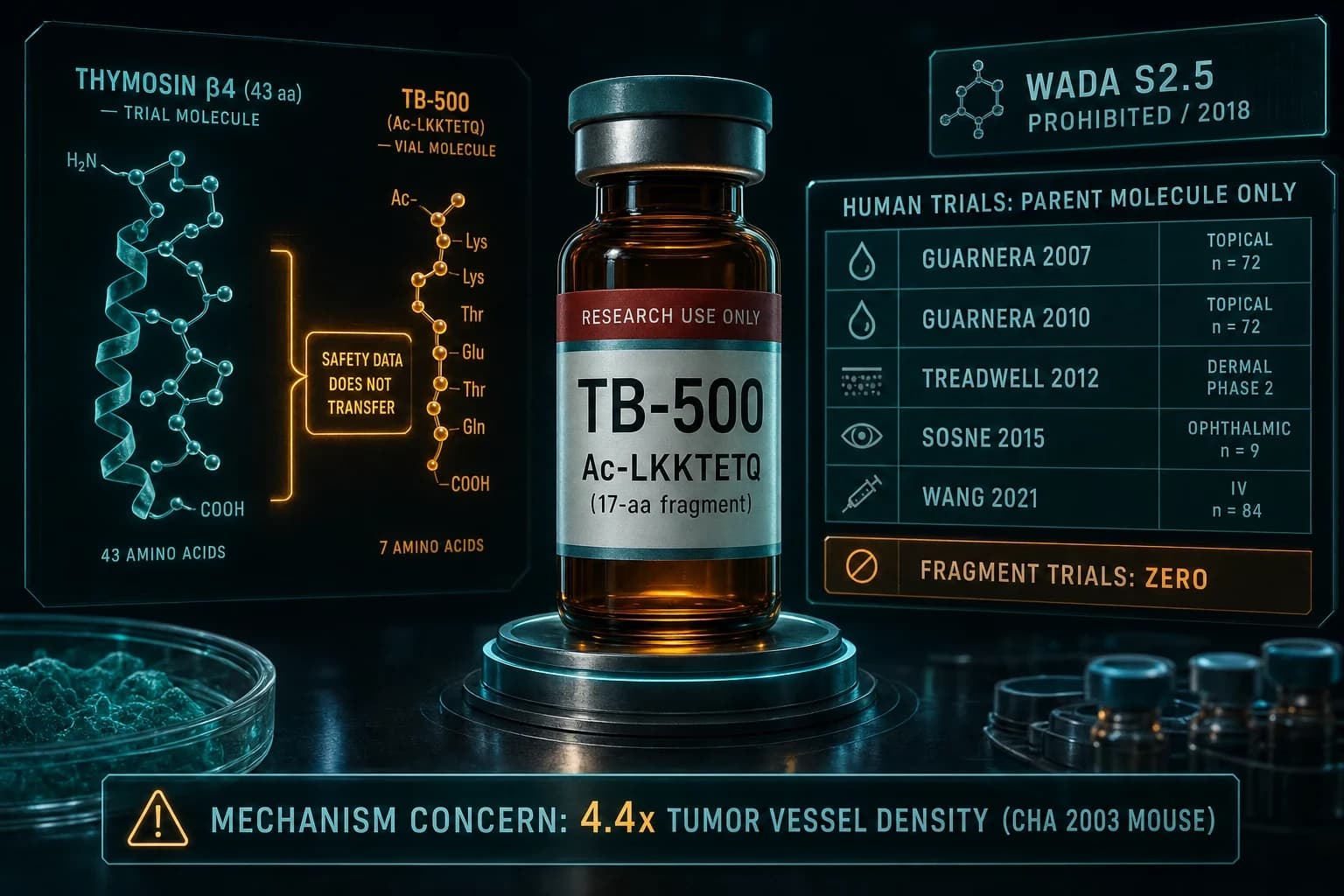
- If you want the contrast with a peptide whose adverse event profile looks different, compare TB-500 side effects and BPC-157 side effects. Thymosin alpha-1 and thymosin beta-4 (TB-500) are structurally unrelated.
Bottom line
Controlled trials of thymosin alpha 1 describe mostly mild effects: local injection-site discomfort and liver enzyme fluctuations in a hepatitis population, with no serious drug-related events recorded in the largest sepsis trial. The serious events in COVID-19 trials occurred in critically ill patients and cannot be cleanly attributed. What the literature does not cover is long-term use in healthy people, immunosuppressed or autoimmune patients, and unregulated product. Those gaps, not the mild effects, are the real unknowns.
This article is for research and educational purposes only and is not medical advice. Thymosin alpha 1 is not FDA-approved in the United States. Consult a qualified clinician before using any peptide.