At a glance
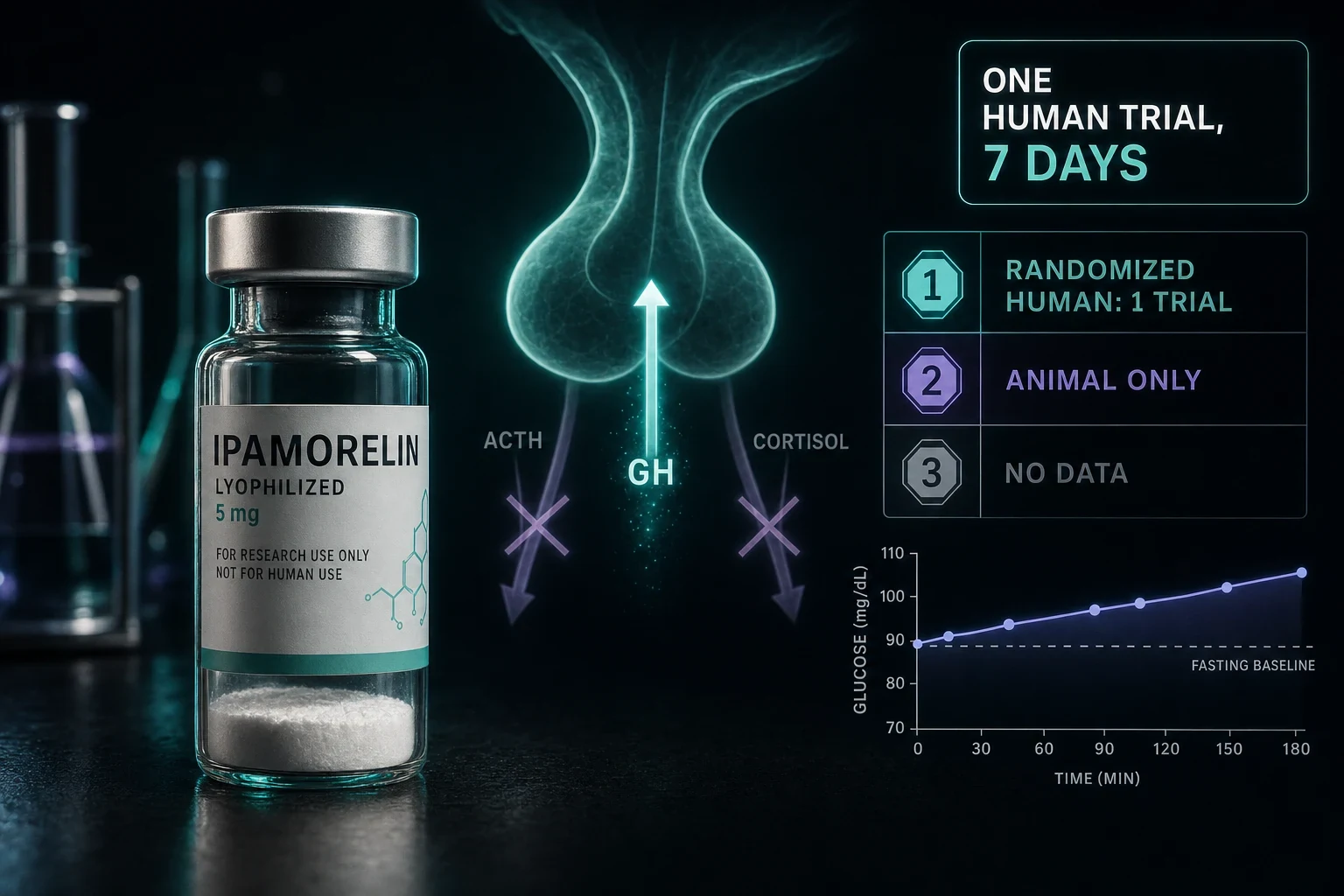
- Ipamorelin has one published randomized human trial, a 2014 postoperative ileus study in bowel resection patients.
- In that trial adverse events hit 87.5% on ipamorelin and 94.8% on placebo, so the signal was not drug-specific.
- In conscious swine, ipamorelin did not raise ACTH or cortisol above GHRH levels, even above 200 times the GH ED50.
- The credible class risk is glucose: oral GH secretagogues raised fasting glucose and lowered insulin sensitivity.
- Long-term use, healthy-adult use, and unregulated vial quality have no safety data at all.
Ipamorelin has exactly one randomized human trial
Search "ipamorelin side effects" and you will get confident lists: headaches, water retention, fatigue, injection-site reactions, tingling hands. Almost none of those pages cite a study, because for ipamorelin specifically there is very little to cite. One randomized, placebo-controlled human trial has been published, and it was not a safety study of healthy adults. It was a 2014 proof-of-concept trial in patients recovering from bowel surgery.
That gap between the confidence of the lists and the thinness of the data is the actual story. This page sorts what is known about ipamorelin tolerability into three tiers: measured in humans, measured in animals, and extrapolated from the drug class. Tier three is where most of the internet's side-effect lists live, and they rarely say so.
For what the compound is and how it compares to its usual partners, see the ipamorelin profile and our sermorelin vs CJC-1295 vs ipamorelin comparison. None of this is medical advice.
Evidence tiers at a glance
| Effect | Evidence tier | What was actually measured | Where it comes from |
|---|---|---|---|
| Overall tolerability | Randomized human | 87.5% of ipamorelin patients and 94.8% of placebo patients had a treatment-emergent adverse event | 2014 bowel-resection trial |
| Cortisol and ACTH rise | Animal | No increase beyond GHRH levels in conscious swine, even above 200x the GH ED50 | 1998 characterization study |
| Elevated fasting glucose, lower insulin sensitivity | Class extrapolation | Measured for an oral ghrelin mimetic, not for ipamorelin | 2008 two-year trial in older adults |
| Hyperglycemia as the leading drug-related event | Class extrapolation | Grade 3-4 hyperglycemia in about 1% on anamorelin | ROMANA 1 and 2 |
| Injection-site reactions | Unmeasured for ipamorelin | No trial reports them; the one human trial used intravenous dosing | None |
| Water retention, carpal tunnel, tingling | Unmeasured for ipamorelin | Recognized with growth hormone itself, never measured here | None |
| Long-term use in healthy adults | Unmeasured | No trial has done it | None |
Note: A blank "Where it comes from" cell is the most useful information on this page. Where there is no study, we are not going to invent a frequency.
What the human trial reported
The 2014 randomized proof-of-concept trial gave intravenous ipamorelin or placebo twice daily to adults after small or large bowel resection, from postoperative day 1 through day 7 or discharge. Treatment-emergent adverse events occurred in 87.5% of the ipamorelin group and 94.8% of the placebo group. The authors concluded the regimen was well tolerated.
Read that comparison carefully. A 87.5% adverse event rate sounds alarming until you see that placebo was higher. Both numbers describe people recovering from abdominal surgery, where nausea, pain and bowel dysfunction are the expected course. The trial can tell you that ipamorelin did not add a detectable burden on top of major surgery. It cannot tell you what a healthy adult experiences, because it did not study one.
The efficacy result matters for how much weight to give the safety result. Median time to first tolerated meal was 25.3 hours on ipamorelin against 32.6 hours on placebo, and the difference was not statistically significant (p = 0.15). No key or secondary efficacy endpoint separated from placebo. The program did not advance. A drug that stops development generates no phase 3 safety database, which is precisely why the evidence here never got thicker.
Bottom line: The only randomized human data on ipamorelin shows no excess adverse events versus placebo in surgical patients over roughly a week. That is a narrow claim, and it is the strongest one available.
The selectivity argument, and its limits
Ipamorelin's reputation for being gentle traces to one paper. The 1998 study that introduced it reported a GH-releasing ED50 of 2.3 nmol/kg in conscious swine and, more importantly, that ipamorelin did not increase plasma ACTH or cortisol beyond the levels seen after GHRH stimulation. GHRP-6 and GHRP-2 both did raise ACTH and cortisol. The lack of effect held at doses more than 200-fold above the GH ED50. The authors described ipamorelin as the first GHRP-receptor agonist with GH selectivity resembling GHRH.
That finding is real and it is the reason researchers prefer ipamorelin over earlier GHRPs. Our GHRP-2 vs GHRP-6 vs ipamorelin comparison walks through the receptor pharmacology behind the difference.
Three caveats keep it from being a safety guarantee. It was measured in swine, not people. "No cortisol rise" is one axis of tolerability, not a full profile. And selectivity for GH release says nothing about what sustained GH elevation does over months, which is a different question from what a single injection does to one hormone.
Other animal work fills in the pharmacology without addressing safety. Ipamorelin induced longitudinal bone growth in rats, shortened time to first bowel movement in a rodent postoperative ileus model, and together with anamorelin inhibited cisplatin-induced weight loss in ferrets. A pharmacokinetic evaluation of peptidyl GH secretagogues found ipamorelin's systemic plasma clearance was five-fold lower than GHRP-6's, with primarily urinary excretion and roughly 20% bioavailability after intranasal application. Useful for understanding exposure, silent on adverse events. For how clearance translates into dosing frequency across compounds, see our peptide half-life chart.
The glucose question is the one worth taking seriously
Ipamorelin raises GH, and GH opposes insulin. That mechanism is not speculative, and it is where the class data become relevant even though they were not generated with ipamorelin.
A two-year randomized trial of an oral ghrelin mimetic in healthy older adults found fasting blood glucose rose by an average of 0.3 mmol/L (roughly 5 mg/dL) and insulin sensitivity fell. In the subgroup that continued for the full two years the fasting glucose increase did not reach significance, while body weight did rise. An earlier two-month trial of the same oral secretagogue in obese men found fasting glucose and insulin unchanged, but oral glucose tolerance testing showed impaired glucose handling at both two and eight weeks. Fasting labs looked fine while the challenge test did not, which is a good argument against judging metabolic effects from a single fasting number.
The injectable ghrelin-receptor agonist with the largest trial program points the same way. In the phase 3 ROMANA 1 and ROMANA 2 trials of anamorelin in non-small-cell lung cancer cachexia, treatment-related grade 3-4 adverse events did not differ from placebo, and hyperglycemia was the most common grade 3-4 event, affecting about 1% of anamorelin patients. The ROMANA 3 safety extension reported treatment-emergent adverse events in 52.2% on anamorelin against 55.7% on placebo, with serious events at 12.8% and 12.6%.
Two honest readings sit side by side here. Across thousands of patients, ghrelin-receptor agonists have looked broadly tolerable. The one consistent drug-related signal is glucose, and it is the effect most likely to carry over to ipamorelin, since it follows from the GH axis rather than from any quirk of a single molecule.
Warning: Anyone with prediabetes, type 2 diabetes, insulin resistance or a family history of it should treat the glucose signal as the relevant risk and involve a clinician before using a GH secretagogue. Baseline and follow-up HbA1c plus fasting glucose and insulin are the minimum way to see it at all. Our lab testing page for ipamorelin lists what batch and bloodwork options exist.
GH secretagogues also do not have an efficacy record that justifies accepting much risk. The same oral compound failed to slow Alzheimer's progression in a 12-month trial of 563 patients despite clear IGF-1 elevation, a reminder that raising a biomarker and changing an outcome are different achievements. Our MK-677 guide covers that oral side of the class in more detail.
Effects commonly listed that have no ipamorelin data
These appear on nearly every page about ipamorelin tolerability. Each is plausible. None has been measured for this compound.
- Injection-site reactions. The only human trial dosed intravenously, so it generated no subcutaneous tolerability data. Local redness or soreness is a property of subcutaneous injection generally, and technique drives much of it. Our injection sites guide covers rotation.
- Water retention, joint aches, carpal tunnel symptoms. Recognized effects of growth hormone excess, which is why they get attributed here. No ipamorelin trial measured them.
- Headache, flushing, transient fatigue. Reported anecdotally across GHRPs. Frequency for ipamorelin specifically: unknown.
- Increased appetite. Mechanistically expected from a ghrelin mimetic and documented as weight gain in animal models, but not quantified in humans on ipamorelin.
- Prolactin elevation. Often asserted. The swine selectivity work addressed ACTH and cortisol; the abstracts do not report prolactin, so we are not going to claim either direction.
Saying "unknown" repeatedly is less satisfying than a frequency table. It is also the only accurate answer, and it changes what a careful researcher does: track your own response, because published data will not predict it for you.
Where the real risk concentrates
The three largest unknowns are not individual symptoms.
- Duration. The human trial ran seven days. The class data run to two years for an oral analogue. Multi-year ipamorelin use has no safety data in any species at research doses.
- Product quality. Trial material was pharmaceutical grade. Research vials vary in purity, fill accuracy and sterility, and contaminants or a mislabeled quantity produce problems no trial would capture. A third-party certificate of analysis is the floor, and our COA library holds the batch documents we have collected for compounds including ipamorelin.
- Stacking. Ipamorelin is rarely used alone; the usual pairing is a GHRH analogue. Adverse events in a stack cannot be attributed to one component, and CJC-1295 has its own profile (see CJC-1295 side effects and tesamorelin side effects). If you are tracking tolerability, changing one variable at a time is the only way the log means anything.
Groups where a prescriber's input matters most: anyone with impaired glucose tolerance or diabetes, anyone with active or prior malignancy (GH and IGF-1 signaling is the open question, not a demonstrated harm), people with significant liver or kidney impairment, and pregnancy or breastfeeding, where there are no data at all.
Sourcing, since product quality is the variable you control
Published trials cannot tell you what is in a vial bought today. Vendor transparency is the part of the risk a researcher can actually act on: third-party HPLC and mass spec results tied to the batch number on the label, not a generic certificate for the compound. Our vendor audit and Ascension Peptides review walk through our batch-COA verification standard. Ascension Peptides stocks COA-verified ipamorelin (5 mg vial) with 50% off using code ENHANCED at checkout. For the GHRH-plus-GHRP combination, our CJC-1295 and ipamorelin dosage chart and the stack protocol cover how the published research handled the pairing.
Bottom line
Ipamorelin's safety file is one week of randomized human data in surgical patients, where it produced fewer adverse events than placebo, plus animal work showing it raises GH without pushing cortisol or ACTH above GHRH levels. That is a genuinely better selectivity profile than the older GHRPs, and it is also a thin file. The risk most likely to be real is metabolic, inferred from the GH axis and measured in other ghrelin-receptor agonists rather than in ipamorelin itself. Everything else on the standard side-effect lists is extrapolation from growth hormone, anecdote, or filler. Treat the glucose question as the one to monitor, treat long-term use as uncharted, and treat vial quality as the risk you can verify.
This article is for research and educational purposes only and is not medical advice. Ipamorelin is not approved by the FDA for any indication and is sold for laboratory research use only. Consult a qualified clinician before using any peptide.