At a glance
- Only ARA-290 and thymosin alpha-1 have randomized human trial data in an inflammatory disease indication.
- KPV and BPC-157 dominate rodent gut-inflammation evidence; neither has a published human efficacy RCT.
- ARA-290 4 mg SC for 28 days regrew corneal small-nerve fibers in sarcoidosis (Dahan et al. 2013).
- Thymosin alpha-1 cut sepsis 28-day mortality from 39.4% to 28.7% in the 361-patient ETASS trial (Wu et al. 2013).
- VIP is a strong macrophage-cytokine mechanism story with no positive phase 3 in a general inflammation indication.
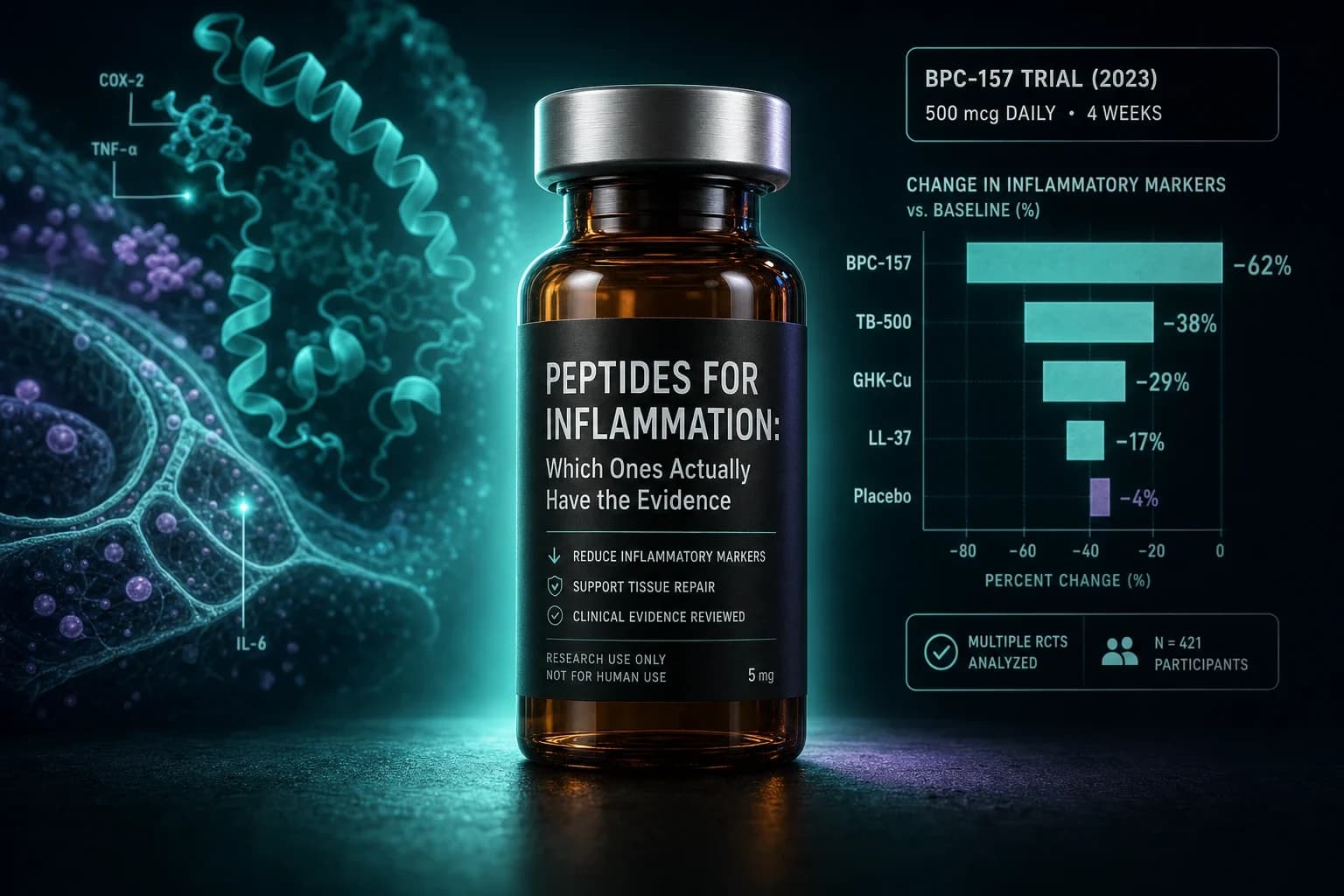
Most "peptides for inflammation" content lumps six or seven compounds into one list and calls them all promising. That framing sells vials. It does not help a researcher decide anything. Two of these peptides have randomized human trial data in a specific inflammatory condition. Two have extensive rodent evidence and no published human efficacy trial. One has strong mechanistic macrophage papers and weak clinical translation. One is genuinely bidirectional and can worsen inflammation if the context is wrong.
This article sorts the six most-searched anti-inflammatory peptides by evidence tier, not by hype. Every claim below is anchored to a real PubMed citation. Where the evidence is only rodent or only mechanistic, the article says so before it says anything else.
The evidence tiers up front
| Peptide | Best human data | Preclinical strength | Delivery | Partner |
|---|---|---|---|---|
| Thymosin alpha-1 | Phase 3 sepsis RCT (n=1,106, TESTS 2025) | Extensive | SC | Ascension + Limitless |
| ARA-290 (cibinetide) | Phase 2 sarcoidosis SFN RCT (n=36, 2013) | Established | SC | Ascension |
| BPC-157 | Phase 2 ulcerative colitis (PL-14736) never fully published | Extensive rodent | SC / oral | Ascension + Limitless |
| KPV | None (formulation development in progress) | Extensive rodent | Oral / SC | Ascension + Limitless |
| VIP | Inhaled aviptadil Phase 2/3 in COVID ARDS, mixed | Mechanistic | Injectable | Ascension + Limitless |
| LL-37 | None as therapy; endogenous role only | Bidirectional | Injectable | Ascension |
The pattern in that table is the whole point. The two peptides with real randomized human evidence in an inflammatory disease indication are also the two most peptide guides underweight. The four that dominate forum discussion (KPV, BPC-157, LL-37, VIP as a research compound) either lack a human efficacy trial or have a mechanism that cuts both ways.
Thymosin alpha-1: the only compound here with mortality-endpoint trial data
Thymosin alpha-1 is a 28-amino-acid peptide originally isolated from thymus tissue. It is licensed as Zadaxin in more than 35 countries (not the US) for chronic hepatitis B and as an immune-modulating adjuvant. Its relevance to an inflammation hub is not the hepatitis B use, it is the sepsis work.
The ETASS trial randomized 361 ICU patients with severe sepsis across six Chinese tertiary hospitals to thymosin alpha-1 1.6 mg subcutaneous twice daily for the first five days then once daily for two days, versus standard care (Wu et al., Crit Care 2013). 28-day all-cause mortality was 28.7% in the treatment arm versus 39.4% in control (p=0.032). The trial was single-blind, which is a real limitation, and the effect size was larger than what subsequent work has replicated.
The follow-up phase 3 TESTS trial (2016-2020, 22 Chinese centers, n=1,106) tested the same intervention in a double-blind design (Wu et al. 2025). The topline mortality signal in the larger phase 3 read was smaller than what ETASS suggested. Systematic reviews since then still find a directional survival benefit that concentrates in high-severity subgroups rather than across all sepsis patients.
The read-through for "peptides for inflammation" as a category: thymosin alpha-1 is the only peptide on this list with mortality-endpoint randomized data in a systemic inflammatory syndrome. That does not make it useful for tendonitis or gut inflammation. It makes it a real immunomodulator with a specific evidence base in critical-illness immune dysregulation.
Deeper compound-specific coverage sits in the Thymosin alpha-1 clinical evidence guide and the Thymosin alpha-1 dosage chart. Both partners carry it: Ascension's injectable vial and Limitless's oral capsule format.
ARA-290 (cibinetide): a positive phase 2 in sarcoidosis small-fiber neuropathy
ARA-290 is an 11-amino-acid peptide derived from the B-helix of erythropoietin. It binds a heteromeric innate repair receptor made of the EPO receptor and CD131 that is only expressed on stressed tissue. That selectivity is why it does not raise hematocrit the way full EPO does; it engages the anti-inflammatory arm without the erythropoietic arm.
The pivotal phase 2 trial by Dahan et al., Mol Med 2013 randomized 36 sarcoidosis patients with confirmed small-fiber neuropathy to 4 mg subcutaneous ARA-290 or placebo daily for 28 days. Results: significant improvement in cold pain threshold (p=0.027), heat pain threshold (p=0.032), and thermal sensory limen (p=0.008), plus a structural finding of increased corneal small-nerve-fiber density on in vivo confocal microscopy. Benefit persisted at 16-week follow-up.
A separate phase 2 in patients with type 2 diabetes and neuropathic symptoms tested self-administered 4 mg subcutaneous ARA-290 daily for 28 days (Brines et al., Mol Med 2015). The trial reported improvements in HbA1c, PainDetect neuropathic symptom score, cholesterol-to-HDL ratio, and corneal nerve fiber density.
The mechanism is dampened innate-immune activation at sites of tissue stress. The evidence tier is real but narrow: the human trials are all in small-fiber neuropathy, not general inflammation. Extrapolating ARA-290 to tendonitis, joint pain, or systemic autoimmunity is not what the current data support.
Full protocol details are in the ARA-290 research guide. Ascension carries the injectable vial.
KPV: the cleanest rodent gut-inflammation package, no human RCT
KPV is the C-terminal tripeptide of alpha-MSH (residues 11-13, lysine-proline-valine). The point of the tripeptide over full alpha-MSH is that it keeps the anti-inflammatory function while dropping the pigmentary and appetite-regulating effects that come with melanocortin-receptor binding.
The mechanistic dissection is Brzoska et al., J Invest Dermatol 2003, which showed KPV suppresses NF-kB activation and blunts IL-1b signaling independent of melanocortin-receptor engagement. The gut-inflammation work is Dalmasso et al., Gastroenterology 2008, which demonstrated KPV is transported into enterocytes via the human peptide transporter hPepT1 (upregulated in IBD tissue) and reduced colitis severity in DSS-induced mouse models. Later work in the same group extended the finding to colitis-associated colon cancer models.
What KPV does not have is a published randomized human efficacy trial. It has a clean mechanism, an oral-bioavailable delivery route, a targeted absorption pathway that concentrates the drug at the disease site, and reproducible rodent data. That is a strong preclinical package. It is not human evidence.
Oral IBD-specific research is covered in more depth in the KPV oral peptide for gut inflammation research review. For dosing conventions, the KPV dosage chart collects the routes and typical research doses. Both partners carry KPV: Ascension for the injectable vial, Limitless for the oral capsule format.
BPC-157: extensive rodent data, one halted phase 2 in ulcerative colitis
BPC-157 is a 15-amino-acid pentadecapeptide (sequence GEPPPGKPADDAGLV) derived from a fragment of body-protective compound in human gastric juice. The Pliva-sponsored clinical development program under trial code PL-14736 reached phase 2 in ulcerative colitis in the mid-2000s. The program was discontinued and no full efficacy report was ever published in a peer-reviewed journal.
What was published is safety data (no serious toxicity or adverse events reported in the trials) and roughly two decades of rodent gastrointestinal work from the Sikiric group at the University of Zagreb. The 2018 review in Current Medicinal Chemistry (Sikiric et al., 2018) pulled the mechanistic and preclinical evidence together: BPC-157 accelerates healing of ethanol-induced gastric ulcers, reduces colonic inflammation in acetic-acid and cysteamine colitis models, and shows tissue-repair effects across gut, tendon, and muscle preparations.
The mechanism most relevant to inflammation is nitric-oxide-system modulation and angiogenesis promotion at injury sites. BPC-157 is not a systemic immunosuppressant. It is a local tissue-repair signal with an incidental anti-inflammatory component. That framing matters because "BPC-157 for arthritis" implies a systemic action the preclinical mechanism does not support.
For a longer look at the human-data gap, see The BPC-157 human clinical data gap explained. The BPC-157 dosage chart covers the route-specific conventions; the BPC-157 side effects article covers the reported safety profile.
VIP: strong mechanism papers, weak clinical translation
Vasoactive intestinal peptide is a 28-amino-acid neuropeptide with broad anti-inflammatory activity in mechanistic studies. The Delgado group's work through the late 1990s and early 2000s established the core findings: VIP inhibits macrophage production of TNF-alpha, IL-6, IL-12, and inducible nitric oxide synthase, and enhances IL-10 (Delgado et al., J Immunol 1999). Endotoxic-shock mouse work (Delgado & Ganea, J Immunol 2000) showed VPAC1-mediated protection from lethal endotoxemia.
Clinical translation has been thin. Inhaled aviptadil (synthetic VIP) went through phase 2/3 trials in COVID-19 ARDS with mixed results; the drug never won FDA approval for that indication. As a research peptide for general "inflammation," VIP has a strong mechanistic file and no compelling randomized efficacy data in any specific inflammatory disease.
The VIP dosage chart covers what the injectable research protocol looks like. Both partners carry VIP. Frame the evidence honestly if you are considering it: strong Delgado-group mechanism papers, no positive phase 3 in an inflammation indication.
LL-37: pro- and anti-inflammatory in the same molecule
LL-37 is the only human cathelicidin, produced primarily by neutrophils and epithelial cells. It is an antimicrobial peptide first and an immunomodulator second, and the immunomodulation runs both directions depending on context (Vandamme et al., Cell Immunol 2012; Wuerth & Hancock 2016).
The anti-inflammatory case: LL-37 suppresses macrophage pyroptosis and LPS-induced IL-1b release, dampens TLR4 signaling in some contexts, and improves survival in mouse sepsis models. The pro-inflammatory case: LL-37 is elevated in psoriatic skin, complexes with self-DNA and self-RNA to activate plasmacytoid dendritic cells via TLR9/TLR7, and is directly implicated in psoriasis pathogenesis.
Practically: LL-37 is not a "give it for inflammation" peptide. Its therapeutic-index case is narrow and highly context-dependent. Research applications tend to focus on antimicrobial rather than immunomodulatory endpoints. The LL-37 dosage chart and the LL-37 cathelicidin antimicrobial peptide guide frame it correctly.
Decision matrix: which peptide fits which research question
| Research scenario | Best-supported peptide | Second option | Evidence caveat |
|---|---|---|---|
| Sepsis / systemic immune dysregulation | Thymosin alpha-1 | None on this list | Phase 3 signal smaller than phase 2 |
| Sarcoidosis / diabetic small-fiber neuropathy | ARA-290 | None on this list | Phase 2 positive; not general "peripheral pain" |
| Inflammatory bowel disease research | KPV (oral) | BPC-157 (oral or SC) | Both rodent-dominant, no positive human RCT |
| Gastric ulcer / GI mucosal injury | BPC-157 | KPV | Sikiric-group rodent literature |
| Macrophage cytokine modulation studies | VIP | Thymosin alpha-1 | VIP is mechanism; TA-1 has some human data |
| Antimicrobial with immune modulation | LL-37 | Thymosin alpha-1 | LL-37 is bidirectional; context-dependent |
| General "inflammation" (unspecified) | Reassess the question | Reassess the question | "Inflammation" is not a single target |
The last row is the honest answer to the query most people are actually running. Inflammation is not a mechanism, it is a category of processes. Which peptide fits depends on which tissue, which cell type, which cytokine axis, and whether the research goal is local tissue repair or systemic immune modulation. A compound that resolves rodent colitis via NF-kB inhibition in enterocytes is not the same tool as one that reduces sepsis mortality via T-cell function restoration.
Stack thinking here follows the same logic. Combining BPC-157 with KPV in a gut-inflammation protocol makes mechanistic sense (mucosal repair plus NF-kB inhibition, both acting locally in the GI tract), which is why it shows up in our wolverine stack protocol family and adjacent thymosin alpha-1 combined immune protocol writeups. Combining ARA-290 with any of the other peptides in a "general anti-inflammatory" stack does not match the evidence and does not follow from the mechanism.
Sourcing, purity, and access
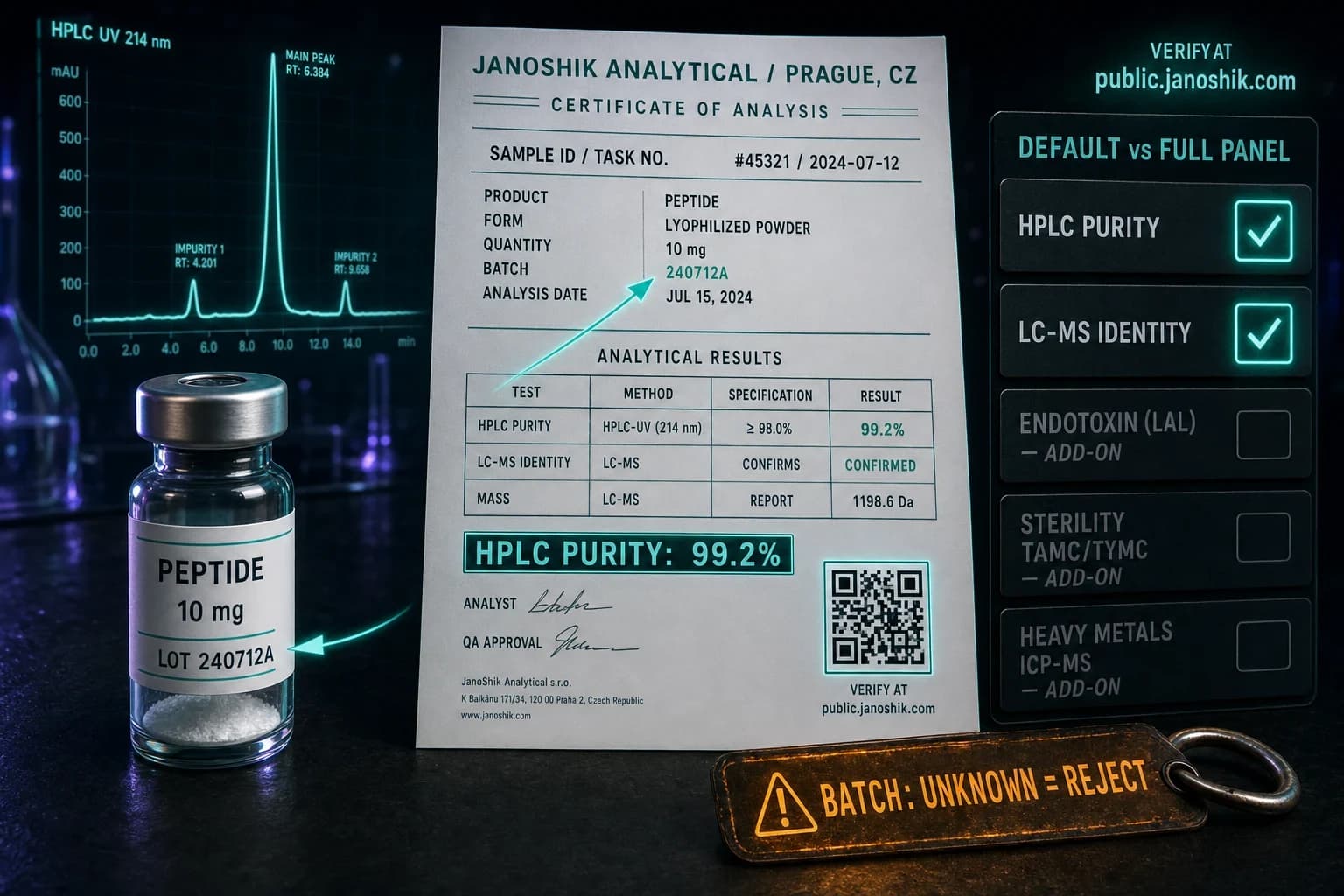
For any of these peptides, source matters more than the choice between them. Purity, endotoxin content, and identity verification via COA determine whether the peptide in the vial actually is the peptide on the label. Our lab tests library collects per-lot COAs where we have them. Ascension Peptides carries the injectable versions of every peptide covered here, with 50% off using code ENHANCED; Limitless Biotech carries oral formulations of KPV, thymosin alpha-1, and BPC-157 with code ENHANCED.
Reconstitution math is the other place research protocols routinely go wrong. The reconstitution calculator handles dose-to-volume conversions and the peptide reconstitution complete guide covers the sterile-technique fundamentals.
Bottom line: Two peptides on this list have randomized human trial data in a specific inflammatory indication (thymosin alpha-1 in sepsis, ARA-290 in sarcoidosis-associated small-fiber neuropathy). Two have extensive rodent data and no published human efficacy trials (KPV, BPC-157). One has strong macrophage-cytokine mechanism papers and thin clinical translation (VIP). One is context-dependent and bidirectional (LL-37). Treat "peptides for inflammation" as a question about which specific disease process you are targeting, not as a category with a single answer.
What we still do not know
The published literature does not tell us whether combining KPV with BPC-157 in a stack produces additive benefit in gut inflammation; the rodent stack data is minimal. It does not tell us whether ARA-290's effect in sarcoidosis extends to non-sarcoid small-fiber neuropathies of similar etiology (post-viral, post-chemotherapy). It does not tell us thymosin alpha-1's efficacy in non-sepsis systemic inflammatory syndromes. And it does not tell us whether any of these peptides preserves benefit past the trial window without ongoing dosing.
Those are the honest boundaries. Rodent data plus a compelling mechanism does not translate into human clinical efficacy without an actual trial, and none of the peptides here that lack such a trial have one on a public timeline as of mid-2026.
Warning: "Anti-inflammatory" is not the same as "immunosuppressive," and neither is the same as "safe." Systemic immune modulation carries context-specific risk. LL-37 in particular can worsen inflammation in psoriatic and autoimmune skin contexts. None of the peptides discussed here are FDA-approved for a general "inflammation" indication. Any decision to use them should involve a qualified clinician.
This article is for research and educational purposes only. Thymosin alpha-1 is licensed outside the US (as Zadaxin) for chronic hepatitis B; ARA-290 (cibinetide) has orphan-drug designation but is not approved. BPC-157, KPV, VIP, and LL-37 are sold as research chemicals under research-use disclosures and are not approved by the FDA for any human indication. Nothing in this article is medical advice. Any decision about peptide use should be made with a qualified clinician who has access to your medical history and can weigh the risks in your specific context.